What Does a Staffing Agency Do for Employers—and What Do You Still Handle?
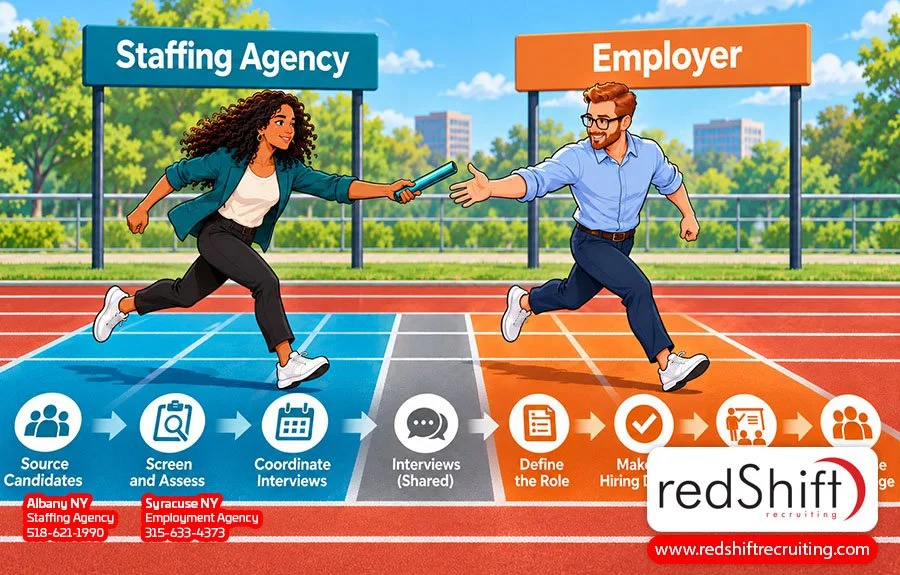
If you hire a staffing agency, what are you actually handing over? Will the recruiter find candidates, arrange interviews, make offers, or handle payroll? Does it depend on the type of staffing arrangement? And what will your company still need to do?
The answer varies based on the agency, the position, and your agreement. Some responsibilities belong to the recruiter, others remain with the employer, and some are shared. Understanding what a staffing agency does for employers and what you'll still need to handle can help you know what to expect before the hiring process starts.
What Does a Staffing Agency Do for Employers?
Staffing agencies typically handle much of the work of finding and evaluating candidates for employers' open positions. Depending on the agency and arrangement, that may include:
Candidate sourcing: Advertising the job opening, reviewing applications, searching existing candidate databases, and reaching job seekers through job boards, social media, referrals, and professional networks. For specialized or higher-level positions, recruiters may also contact experienced professionals who aren't actively looking for new job opportunities.
Screening applicants: Handling initial resume reviews, conducting preliminary interviews, and assessing whether candidates have the experience and qualifications needed for the role.
Discussing job expectations: Confirming compensation expectations, schedules, location, work arrangements, and other factors that could affect whether the opportunity is a good match for the candidate.
Presenting candidates: Recommending qualified candidates to the employer or hiring manager, helping identify the right candidates for the position, and providing context about their experience or interests that a resume may not show.
Coordinating the hiring process: Scheduling interviews, communicating updates and next steps to job candidates, gathering employer feedback, refining the search when needed, and assisting with offers and negotiations. For temporary staff, they also manage the administrative side of the onboarding process.
Additional screening services: Depending on the agreement, the agency may also coordinate skills assessments, reference checks, background checks, drug screening, or other background screening and compliance verifications.
Providing market insights and advice: Sharing data and expertise regarding candidate availability, compensation expectations, market trends, and how job requirements affect the search. For example, a recruiter might discover that a required certification is limiting the candidate pool or that qualified applicants consistently expect a higher salary. The agency can recommend changes and assist with strategic workforce planning, but the employer decides whether to adjust the requirements or compensation.
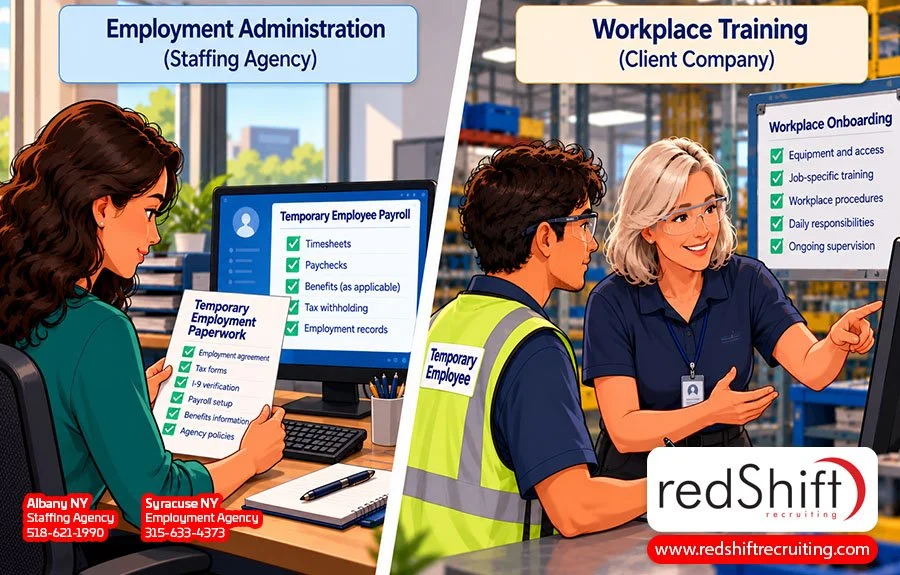
Managing temporary employment: For temporary and temp-to-hire placements, agencies generally handle payroll, employment paperwork, and related administration. They may also help address attendance or performance concerns, communicate with workers during assignments, and coordinate replacements or assignment changes with the client.
The specific services vary among staffing companies. Some staffing agencies work primarily on permanent hires, while others offer temporary staffing, contract-to-hire placements, or a combination of services. Confirm what's included before the search begins.

Does the Staffing Model Change Who Handles What?
The division of responsibilities can change significantly depending on the staffing model. Staffing firms, including traditional temp agencies and other employment agencies, may recruit for permanent positions, provide temporary workers for short-term placements, or help companies find contract workers for specialized projects. Some also assist with sourcing independent contractors, although those arrangements differ from traditional temporary staffing and depend on how the working relationship is structured.
One of the biggest differences between common staffing models is who employs the worker and handles payroll and employment administration.
| Staffing Model | How It Typically Works |
|---|---|
| Direct Hire | The agency recruits for a permanent position. The selected candidate becomes the client's employee upon hire, with the client handling payroll, benefits, and employment administration. |
| Temporary / Contract Staffing | The agency generally employs and pays the temporary worker, handling payroll and related employment administration. The client directs daily work and supervises the assignment. |
| Temp-to-Hire / Contract-to-Hire | The worker generally starts as an agency employee. If the client offers permanent employment and the worker accepts, payroll and employment administration shift to the client upon conversion. |
In a typical temporary staffing arrangement, the agency employs the worker, handles payroll, and manages employment taxes. This generally includes withholding and paying applicable Social Security and Medicare taxes, as well as handling unemployment taxes. As the legal employer, the agency typically maintains workers' compensation coverage for its employees and handles benefits administration when benefits are offered.
These flexible staffing solutions can provide temporary placements for seasonal or project-based work while reducing the client's employment-administration burden. However, the client still directs the worker's daily activities and supervises their work.
Under a temp-to-hire or contract-to-hire arrangement, employment administration generally shifts from the agency to the client when the worker becomes a permanent employee.

What Does the Employer Still Need to Handle?
Even when a staffing agency handles most of the recruiting process, certain decisions and responsibilities remain with you. The following table provides a quick overview of how the work is typically divided between the employer and the agency.
| Responsibility | Who Typically Handles It? |
|---|---|
| Define the position and hiring requirements | Employer, with agency input |
| Choose the staffing arrangement and approve the budget | Employer, with agency advice and agreed terms |
| Find and initially screen candidates | Usually agency |
| Coordinate interviews and candidate communication | Usually agency, with employer participation |
| Interview and select candidates | Usually employer; may be delegated in some arrangements |
| Provide candidate feedback and refine the search | Employer provides feedback; agency adjusts the search |
| Approve and communicate offers or assignment terms | Employer approves its terms; agency often coordinates communication |
| Handle payroll and employment paperwork | Usually agency for temporary staffing; employer for direct hires |
| Provide workplace orientation and job-specific training | Usually employer, with some requirements coordinated by agency |
| Assign and supervise daily work | Usually employer |
| Address temporary worker attendance or performance concerns | Employer and agency coordinate |
| Communicate changes to temporary assignments | Employer informs agency; both coordinate as needed |
| Decide whether to offer permanent employment | Employer decides; agency may coordinate the offer or conversion |
Note: These reflect common staffing arrangements, not universal rules. Responsibilities depend on the agency, agreement, position, and applicable laws. Some legal obligations, including workplace safety, may be shared.
The table provides a general overview, but some of the employer's responsibilities deserve a closer look, particularly those that require knowledge of the job, internal decisions, or direct involvement with employees.
1. Define What You Actually Need
A recruiter can help clarify a role, refine requirements, and suggest alternatives. But you have to establish why the position exists and what the new hire is expected to accomplish. That includes:
What work needs to be done and why
Which skill sets and qualifications are essential and which can be learned on the job
Who the employee reports to and how the role fits the team
Schedule, work location, pay range, and other conditions
What strong performance looks like
Your working environment, company culture, and expectations for how the person will work with others
The agency can use that information to develop a realistic recruiting plan or question requirements that seem unnecessarily strict. But finding the right person starts with knowing what the position actually requires, not just writing a job description. Be clear about the role and your hiring priorities before the search begins, even if an agency handles the sourcing.
2. Make the Hiring Decision
Agencies can evaluate candidates, recommend strong matches, and point out transferable experience that hiring managers might overlook on a resume. But the employer usually decides who gets interviewed, who advances, and who gets the job.
There are exceptions, especially for temporary positions. A manufacturer that regularly uses the same agency might provide standing requirements and authorize it to send qualified workers as needs arise, without interviewing each person. In contrast, a direct-hire search for a department manager would typically involve more employer participation in interviews and selection.
You also decide which staffing arrangement you need and approve the compensation budget and employment terms you're prepared to offer. A recruiter can advise on competitive pay and recommend an approach, but decisions about your company's staffing needs and budget remain with you.
These decisions may continue after an assignment begins. For example, you may decide to hire a temporary or contract-to-hire worker permanently, including earlier than originally planned. If the worker accepts your permanent employment offer, the agency can then coordinate the conversion according to the terms of the agreement.
Whatever the arrangement, both the employer and the agency should understand who has the authority to approve candidates, offers, and employment changes.
3. Evaluate Candidates Against the Actual Job
A recruiter may know a great deal about a candidate's background, qualifications, and reasons for considering a new position. But the hiring manager usually knows more about the actual workplace: the team, internal systems, day-to-day responsibilities, and expectations that may not be fully captured in a job description.
An agency might find an accountant with the right technical experience and software knowledge, but you still need to determine whether that person can handle your particular reporting requirements, work independently, and coordinate with other departments.
The recruiter evaluates candidates against the search requirements. You bring the knowledge needed to judge how someone would perform in your actual workplace.
4. Provide Candidate Feedback and Communicate Changes
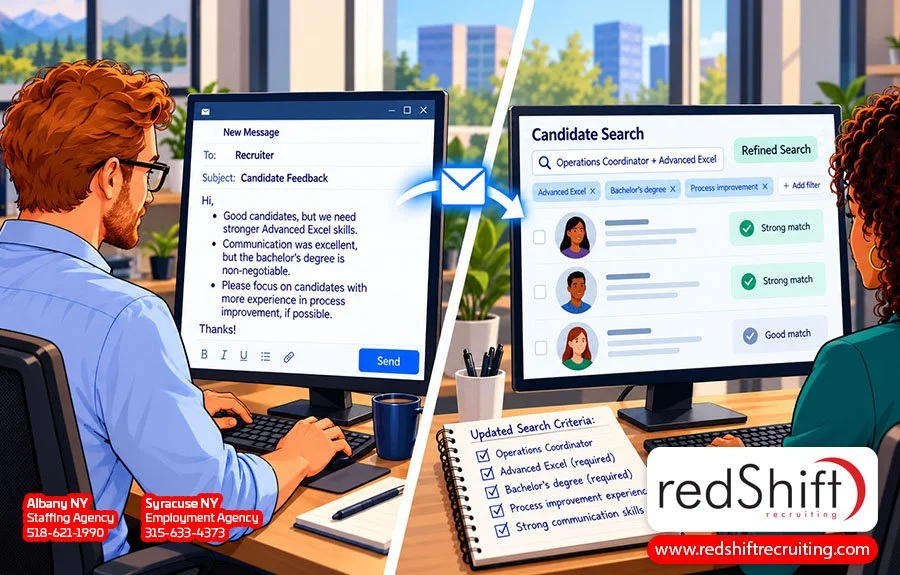
The agency can find and recommend candidates, but your feedback helps the recruiter understand which qualifications and experience are most important for the actual job. Timely feedback also allows the recruiter to keep candidates informed and move the hiring process forward before interested applicants move on to other opportunities.
For example, you might explain:
"This candidate had the technical experience we needed, but not enough experience managing a team."
"We really liked this person's communication skills, but the bachelor's degree is a firm requirement."
"After interviewing the first few candidates, we realized we need someone with more advanced Excel skills than we originally specified."
These details are more useful than simply saying a candidate isn't a fit. They help the recruiter adjust screening questions, refine the search, or find other candidates with the qualifications you're looking for. Sometimes, reviewing the first few candidates also helps an employer recognize priorities that weren't clear in the original job description.
You'll also need to communicate other changes, such as new requirements, a different compensation budget, a revised hiring timeline, or a decision to pause or close the position. This allows the recruiter to adjust the search rather than continue working from outdated information.
5. Prepare for and Manage Temporary Employees Once They Start
For temporary and temp-to-hire positions, there's an important distinction between employment onboarding and workplace onboarding. The agency generally handles employment paperwork, payroll documentation, and its own employment policies. Depending on the arrangement, it may also coordinate required pre-assignment documents or screenings.
You still handle the practical preparation, much as you would for your own new hires:
Introducing the worker to the team and workplace
Providing equipment, system access, and necessary resources
Explaining job-specific procedures and expectations
Training on internal processes and workplace procedures
Assigning and supervising daily work
Monitoring performance and raising concerns with the agency
For example, a company might bring in a temporary administrative assistant through a staffing firm. The agency handles payroll and employment administration, but you still need to explain how your office operates, provide system access, assign work, and supervise the assistant's daily responsibilities.
You'll generally need to verify or approve hours worked so the agency can process payroll. Changes to an assignment's schedule, duties, or expected end date should also be communicated to the agency. If attendance or performance problems arise, the agency may help address the issue, end the assignment, or arrange a replacement, depending on the circumstances and agreement.
Workplace safety also deserves special attention. The staffing agency and client company share responsibility for temporary-worker safety, although their specific duties may differ. For example, the agency might provide general safety orientation, while the client provides training on the equipment, procedures, and hazards at its worksite. Both parties should establish how these responsibilities will be handled.
Hiring through a staffing agency doesn't necessarily mean the agency manages the worker at your site. Temporary employees still need workplace direction and support from you.
What Should Be Clear Before the Search Starts?
Knowing how staffing agencies work is helpful, but the exact division of responsibilities depends on your service agreement. Before recruiting begins, make sure both sides understand:
Services: Which recruiting activities, screenings, and checks are included.
Selection: Who updates candidates, conducts interviews, and approves new hires or assignments.
Employment administration: Who handles payroll, employment paperwork, and benefits administration when applicable.
Assignment management: How timesheets, attendance issues, replacements, and assignment endings are handled.
Offers and conversions: Who coordinates offers, how permanent conversions work, and whether early conversion is permitted under the agreed terms.
Costs: How fees are calculated, what they cover, when payment is due, whether conversion fees apply, and what replacement guarantees, if any, are included.
Practices can vary across the staffing industry, even among agencies offering similar services. Industry-specific agencies and other specialized agencies may also have different processes or services for the types of positions they fill.
Before choosing the right staffing agency for your needs, consider its experience with similar positions, screening process, and reputation. A good agency should be able to explain what services it provides, how its process works, and what it expects from your company. The Better Business Bureau, client references, and other independent reviews can provide additional information about a potential staffing vendor.
Understanding what's included, what you'll pay, and what your company still handles gives you a clearer starting point for working effectively with your staffing agency.
Frequently Asked Questions
Do Employers Pay Fees to Staffing Agencies?
Yes. Employers pay fees for recruiting and staffing services, but the fee structure depends on the arrangement. For direct hire, agencies commonly charge a placement fee based on a percentage of the new employee's salary, although flat fees, retainers, and other arrangements are also used. Temporary staffing costs typically include the worker's pay and an agency markup covering employment costs and services. Employers should confirm what's included and when payment is due.
Can an Employment Agency Fill Just One Position?
Yes. You don't need multiple openings or ongoing staffing needs to work with an agency. Many staffing agencies fill single roles, whether it's a temporary job, a specialized technical position, or a permanent hire.
Can Staffing Companies Recruit for Specialized or Higher-Level Positions?
Yes. Some agencies focus on a particular industry or role type, such as information technology, engineering, accounting, and management. Their recruiters often have the networks and background to find candidates with the right technical skills or industry experience.
Can an Employer Hire a Temporary Worker Permanently?
Often, yes. Some placements are arranged as temp-to-hire opportunities, while others begin on a strictly temporary basis. In either case, an employer usually has the option to offer a temporary worker permanent employment, including earlier than originally planned. The worker must accept the offer, and the process, timing, and any conversion fees depend on the staffing agreement.
Conclusion: Knowing Who Handles What Makes Staffing More Effective
Working with a staffing agency doesn't mean handing over the entire hiring process. The agency can take on much of the work involved in finding, screening, and coordinating candidates and, depending on the staffing model, may also handle payroll and employment administration. You still define the business need, make or approve important hiring decisions, and manage the work once someone starts. Understanding who handles what helps you make better use of the agency's services while ensuring your own responsibilities don't get overlooked.
Need help finding the right people for your team? RedShift Recruiting can help you explore your staffing options and find qualified candidates for your open positions.
Contact Us

Article Author:
Ashley Meyer
Digital Marketing Strategist
Albany, NY
from Career Blog: Resources for Building a Career - redShift Recruiting https://www.redshiftrecruiting.com/career-blog/what-does-a-staffing-agency-do-for-employers
via redShift Recruiting



Comments
Post a Comment