Is Your Accounting Department Understaffed? How to Identify the Right Kind of Help

The staff accountant hasn't left before 7 PM in weeks. The invoices get processed eventually, but reconciliations keep getting bumped, and everyone has quietly accepted that as normal. A few doors down, the CFO is two hours into a task that has nothing to do with strategy or forecasting—it's work that should belong to the controller role that's been vacant since spring. Meanwhile, every payroll question still routes to the former payroll coordinator, who got promoted six months ago but is still the bottleneck for a task that isn't supposed to be hers anymore. Ask any of them if the department needs help, and they'll say yes without hesitation.
So is your accounting department understaffed? In each of these scenarios, probably. But "we need to hire" and "we know who we need to hire" are two different statements. The staff accountant needs someone to take enough routine work off her plate that reconciliations and core responsibilities stop getting pushed back. The CFO needs a specific hole in the org chart filled, while the payroll bottleneck needs someone who actually knows payroll, not just another accountant. Before jumping straight to the job posting, pause to ask where specifically the work is piling up, who's currently compensating for it, and why? Answering those questions is the first step to solving your staffing problem instead of just increasing the number of employees.
Where Is Your Accounting Team Feeling the Strain?
An understaffed accounting team can keep functioning for a surprisingly long time before the problem becomes impossible to ignore. Over time, however, understaffing can contribute to employee burnout and turnover, make segregation of duties harder to maintain, weaken internal controls, and increase the risk of accounting errors, missed tax or regulatory deadlines, and compliance problems. Before deciding who to hire, look at what is actually happening in the day-to-day work:
Which responsibilities consistently take longer than they used to?
What work requires frequent overtime or constant catch-up?
What gets postponed whenever things get busy?
Are account reconciliations, month-end/year-end close, AP/AR, payroll, audit prep, or other accounting processes eating more time than they should?
Are delays in reconciliations, reporting, or reviews interfering with the team's ability to provide timely, accurate financial data?
Have short-term workarounds that were meant to be temporary gradually become the permanent process?
Does one person's absence throw off the entire accounting team?
From an outsider's perspective, a department can look like it's keeping up and still realistically be in trouble. Staffing problems usually start long before employees are visibly burned out or struggling to meet deadlines. If tasks are regularly landing on the wrong employees, if manual work is quietly consuming hours that should go toward higher-value analysis, or if the same short-term workaround has become permanent, those are signs the current staffing model isn't holding up, even if the team appears to be keeping pace.
Is the Problem Workload, Work Distribution, or Missing Expertise?
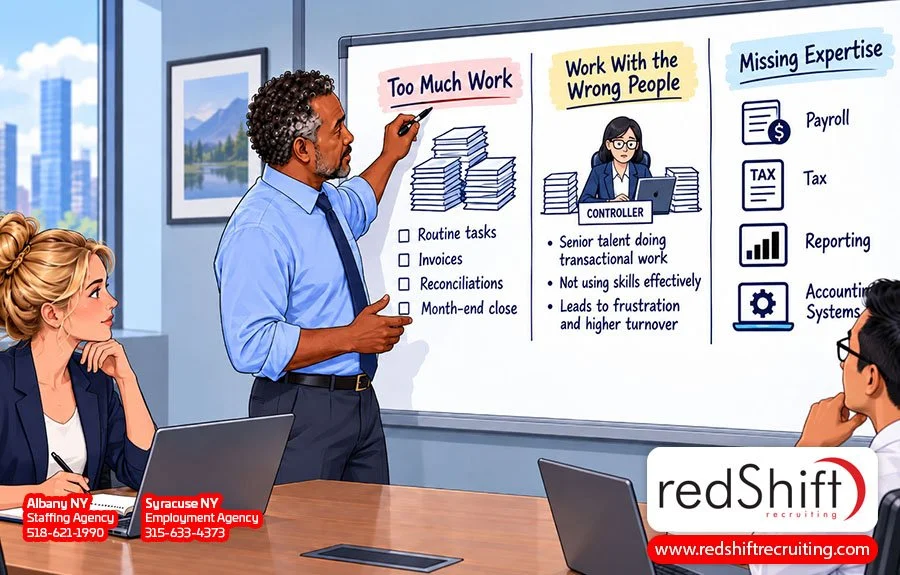
Once you’ve identified the source of the strain, the next question is why it's happening. In most cases, it comes down to one of three challenges: there's too much work for the team to handle, the work is landing on the wrong people, or the team is missing a skill it doesn't currently have.
Is There Too Much Work for Your Existing Staff to Handle?
Unfinished tasks, missed deadlines, and low morale are some of the clearest signs of an understaffed accounting department. Your current workforce may have the right skills; there just isn't enough time in the day to get through everything. Overwhelming workloads can usually be traced back to business growth, a chronically unfilled position, seasonal or year-end pressures, increased reporting or compliance demands, or a task list that’s simply crept up gradually until it’s too much for the current team.
Are Tasks Sitting on the Wrong People’s Desks?
This one can be harder to spot, because the work is still getting done; it’s just not being done by the right people. Accounting duties can vary widely by company size, industry, and team structure, so the issue isn’t whether a particular task can ever belong to a certain role. It’s whether employees are regularly spending too much of their time on work that pulls them away from the responsibilities where their experience is most needed.
Think of a controller spending hours each week on routine transaction entry, a senior accountant consistently buried in AP work, or a manager regularly covering an unfilled junior role. There’s nothing wrong with experienced accounting staff stepping in on more routine or transactional work. The trouble starts when it becomes part of their normal day-to-day. A controller's or senior accountant's time is expensive, and using too much of it on routine work can hurt profitability over time when higher-value analytical, review, or planning responsibilities keep getting pushed aside. Constant handoffs and employees regularly covering unfamiliar accounting functions can also create more opportunities for mistakes, errors, and missed details, making it harder to tell whether the real problem is workload, role design, or missing expertise.
Is a Skills Gap Making Your Team Rely on the Wrong Person?
If team members have to scramble every time a payroll issue, a tax question, or an audit request comes up, it may be a skills gap rather than a capacity issue. Payroll rules, tax codes, and reporting requirements vary across industries, and hiring another accounting generalist may not address that kind of knowledge gap. In these situations, your team may need someone with specific expertise, industry experience, or specialized knowledge, whether that's a new hire, a consultant, or a contract employee.
Who Is Currently Covering the Gap?
Most understaffed departments find ways to cope. The question is who's absorbing the work, and what that's costing both them and the company.
Has a manager or controller taken on tasks that normally belong to another role on the team?
Did another accountant inherit part of an open role?
Have several people split up the responsibilities?
Are administrative staff regularly handling accounting tasks that are outside of their normal job description?
Has some of the work simply stopped getting done?
Rather than focusing on who looks the busiest, look at who isn't getting to essential or high-value tasks because they're picking up the slack. For example, a controller who's spending a substantial part of their week on routine data entry tasks may have less time for financial review, controls, or oversight, while an accounting manager repeatedly handling payroll questions has less time for staff development, reporting, or process improvement. Recognizing the trade-offs that are already happening usually gives more insight into what the department needs than a general sense that everyone's overworked.
What Kind of Accounting Help Would Actually Relieve the Pressure?
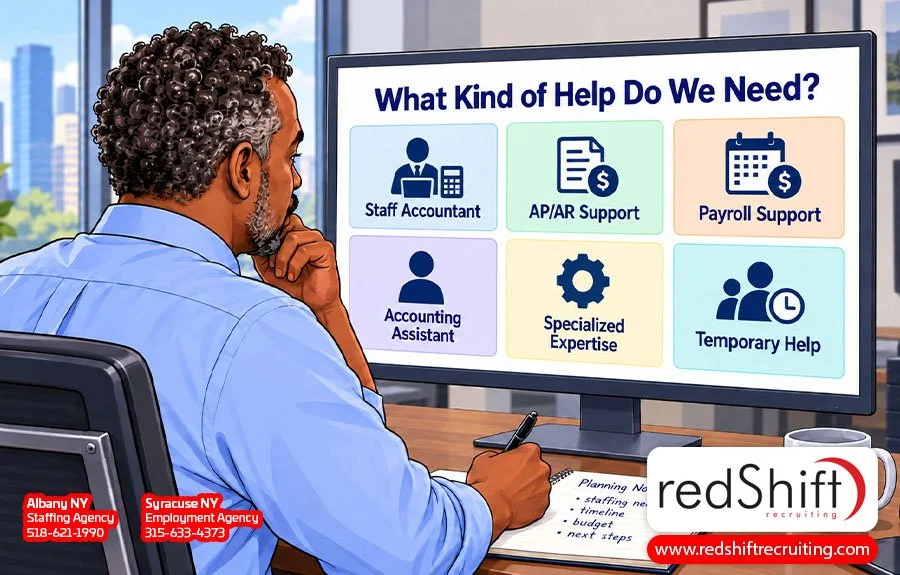
Once the cause and consequences are clear, you'll be in a much better position to identify the type of help your team needs. Broadly, these tend to fall into a few categories:
Transactional or day-to-day support. AP, AR, bookkeeping, payroll processing, reconciliations, data entry, or similar tasks may be handled by an accounting clerk, AP/AR specialist, bookkeeper, payroll specialist, accounting assistant, or, in some organizations, a staff accountant.
General accounting capacity. Someone who can take responsibility for broader accounting functions, such as a staff accountant or a senior accountant, depending on how much independence the work requires.
Higher-level or specialized expertise. When the issue is the complexity of the work rather than the volume of it, the fix is different. These needs may call for senior accounting or management-level experience, or specific expertise in tax, audit, reporting, or systems. For some organizations, this doesn't require a full-time hire at all: hiring a specialized consultant, outsourcing specific tasks, or employing contractors can all bring that experience in-house without adding to the permanent headcount. Even at the finance-leadership level, a fractional CFO can provide experienced financial leadership without the commitment of a full-time executive.
Short-term or project support. This may include covering an employee leave, filling a temporary vacancy, addressing a seasonal crunch, or preparing for a project such as an audit, backlog cleanup, or a system implementation. Temporary accounting support can provide short-term coverage and specialized services without the commitment of a full-time hire. Temp hires also offer the benefit of getting essential support in place while you assess whether long-term help is needed.
As you identify the type of role you need, keep in mind that titles vary substantially by employer, company size, or industry, and two companies may use the same title for very different levels of responsibility. The work should define the job title, not the other way around, so choose based on the work the position will actually own.
What Should the New Hire Take Off the Existing Team’s Plate?
Before writing a job posting, define the change the hire is supposed to make. Identify:
What responsibilities will actually move to this person?
Which employees get time back, and how much?
What should those employees be doing instead?
Which delayed projects should become manageable again?
What, specifically, should be different a few months after this person starts? Define what success looks like.
These answers give you a clear framework for assessing whether the hire actually solved the problem it was meant to solve, rather than simply adding headcount without addressing the underlying issue. It's also what will help you determine later whether you have enough staff or still need to hire.
When Is the Problem Bigger Than Another Hire?
If the problem is an underlying structural or process issue, adding another person probably won't fix it. A new hire won't solve:
unclear ownership over the work itself;
duplicated effort across roles;
inefficient processes that create extra work regardless of staffing;
recurring last-minute demands from other departments that prevent accounting staff from focusing on their core tasks;
outdated technology, systems, or manual processes that slow everyone down.
These problems aren't solved by hiring alone. Adding a new person to an inefficient or poorly defined process can create more handoffs, more opportunities for mistakes, and potentially make the situation worse. Check whether these structural issues are involved before assuming an additional person will fix a problem that's really about how the department is operating, not how many people are in it.
Before You Decide on the Job Title, Define the Missing Piece
At this point, you should be able to answer:
Where is the team feeling the pressure?
Is the cause workload, work distribution, or missing expertise?
What responsibilities should the new hire own?
What level of experience does that require?
Is the need ongoing, temporary, or project-based?
What should change for the existing team once the role is filled?
With those answers in hand, an HR manager or recruiter can help translate the defined need into the right title, a realistic candidate profile, fair compensation, and a search strategy that targets qualified candidates. A clear diagnosis turns a vague hiring request into a search that recruiters, candidates, hiring managers, and accounting leaders can all understand.

Frequently Asked Questions
What If the Department Has More Than One of These Problems at Once?
That's common, not a sign the diagnosis is off. A team can be genuinely short on hands and have a senior person doing junior-level work and be missing a specific skill. Those three things often compound rather than exist in isolation. An effective fix may mean hiring two or more different roles, or a single new hire paired with reassigning existing work. The diagnosis may not land on one clear answer, but it will help you make a hire that solves a real problem instead of just adding staff and hoping the pressure eases.
Should We Hire a Full-Time Employee, or Bring in a Contractor or Temp First?
That usually comes down to how confident you are in the diagnosis and how long the need is likely to last. A seasonal spike, a leave coverage gap, or a backlog that needs clearing are good candidates for temporary help, as you don't need a permanent hire for a problem that resolves itself in a few months. A regular workload gap may require a full-time employee to resolve, while a specialized need could be permanent, contract, or outsourced depending on how often the expertise is needed.
How Do We Make the Case to Leadership for a New Hire?
The diagnosis itself is the case. "We're busy" doesn't push a budget conversation; "our controller has spent 10 hours a week for three months on routine transactional work, and review of the financials has slipped as a result" does. Leadership tends to respond once they understand the cost of inaction more than a general sense of strain, whether that cost is in delayed reconciliations, increased audit risk, or a specialized employee's attention pulled from the high-value work they were hired to do. The analysis that identified who's covering the gap and what they're not getting to as a result is exactly what makes that case concrete.
How Long Should This Diagnosis Take Before We Start Recruiting?
Usually days or a few focused conversations, not an open-ended planning exercise. Most of it comes down to a few honest conversations with the people currently absorbing the extra work and a clear-eyed look at where deadlines have been slipping. The risk is in skipping the diagnosis altogether and going straight to a job posting for "another accountant" because that's the default answer. A short, focused gut check is what keeps the search from becoming a longer, more expensive detour later.
What If We're Not Sure the Diagnosis Is Right Until After We Hire?
It's fine to treat the first hire as a working hypothesis rather than a guaranteed fix. If the pressure doesn't ease the way you expected, it may mean the real issue was slightly different than assumed, not that hiring was the wrong move entirely. A recruiter is an invaluable resource in these situations, as they can help you reanalyze the situation and adjust the next search accordingly.
Conclusion: Turning an Understaffed Accounting Department Into the Right Hire
Knowing your accounting department needs help is the easy part. The harder question is whether the team needs more capacity, a different distribution of work, or expertise it doesn't currently have.
Look at what's being delayed, who's covering the gap, and what you want that person's workload to look like. That gives you something much more useful than a request for “another accountant.” From there, you can choose the role, level, and type of support that gives the accounting team enough room to do its work well, both now and as the business changes in the future.


Article Author:
Ashley Meyer
Digital Marketing Strategist
Albany, NY
from Career Blog: Resources for Building a Career - redShift Recruiting https://www.redshiftrecruiting.com/career-blog/accounting-department-understaffed
via redShift Recruiting



Comments
Post a Comment