Can AI Reduce Staffing Needs? What Employers Should Consider Before Changing a Hiring Plan
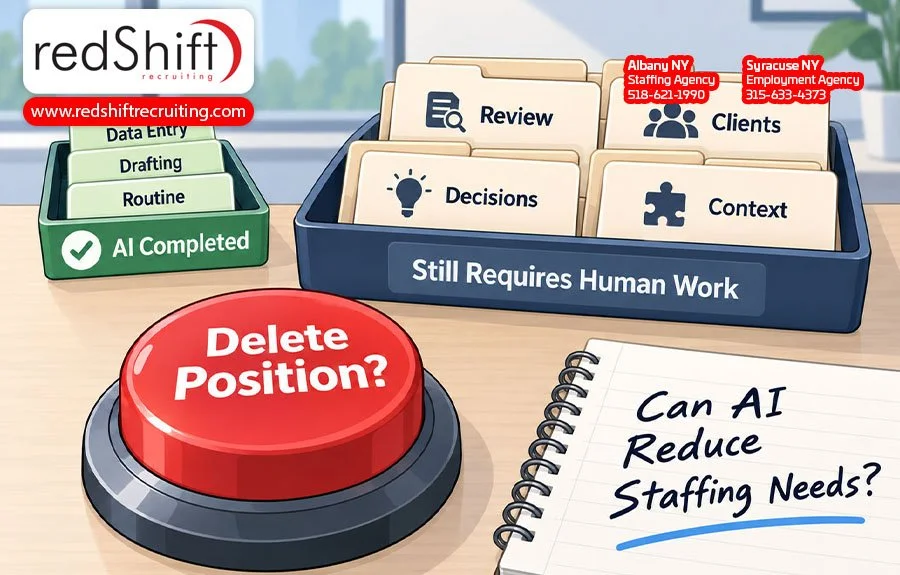
Unless you've been living entirely off the grid for the last few years, you know that AI is significantly changing how work gets done and who does it. AI can make a five-hour task take two. It can speed up research, automate repetitive tasks, reduce human errors, and give employees more time to focus on work that requires judgment or human expertise. But does that mean an AI system can remove the need for a new hire?
The answer is far less straightforward than some of the headlines suggest. AI has clearly changed what certain roles look like, and in some cases, it has reduced how much work is left for a person to do. But in others, the calculation is more complicated. Sometimes, AI can complete part of the work, but human interaction itself is the more important element. Sometimes it still needs someone checking or correcting the output. And sometimes, AI simply makes current employees faster or better at their job without removing enough work to make a proposed hire unnecessary.
That's why "Can AI reduce staffing needs?" isn't a yes-or-no question. Before making major decisions, employers need to look at what the technology is actually changing, what work still needs a person behind it, and whether those changes are significant enough to alter a hiring plan.
Has AI Actually Reduced the Staffing Need?
For many companies, employees are both a major asset and a significant ongoing investment. A new hire costs more than salary alone, with expenses ranging from job postings and onboarding to benefits, training, and payroll-related costs. So it's not surprising that some business leaders would look at the increasing capabilities of AI technologies and ask whether AI adoption could reduce the need to hire human workers.
The answer depends on what has actually changed. AI's impact on a role is usually more complicated than headlines about either an AI revolution or AI failure suggest. Before changing a hiring plan, employers need to separate proven AI capabilities from expected or theoretical ones.
Start with the basics:
Which tasks are now automated or completed faster with AI models?
How much employee time does that consistently save in practice?
How much review, correction, or follow-up does the AI-assisted work still require?
Has the total workload actually decreased?
Has AI deployment created time or opportunities for workers to concentrate on other valuable work?
When a position is open, are managers or coworkers absorbing the work that belonged to the missing employee, or is an AI agent reliably handling enough of it to reduce the need for additional help?
Productivity gains from AI deployment are real. Using survey data collected throughout 2024 and 2025, researchers at the Federal Reserve Bank of St. Louis estimated that reported generative AI time savings were equivalent to about 1.6% of all work hours across the U.S. workforce, including workers who did not use the technology.
That finding shows that generative AI can save real time at work, but it doesn't tell an individual employer whether AI integration makes their planned hire unnecessary. There is a clear difference between using a tool to complete certain tasks like data entry or document drafting faster, and using it to remove a position's worth of work. Employers still need to look at how much employee time AI has consistently freed up and what work still remains to be done.
What Work Still Needs Human Ownership?
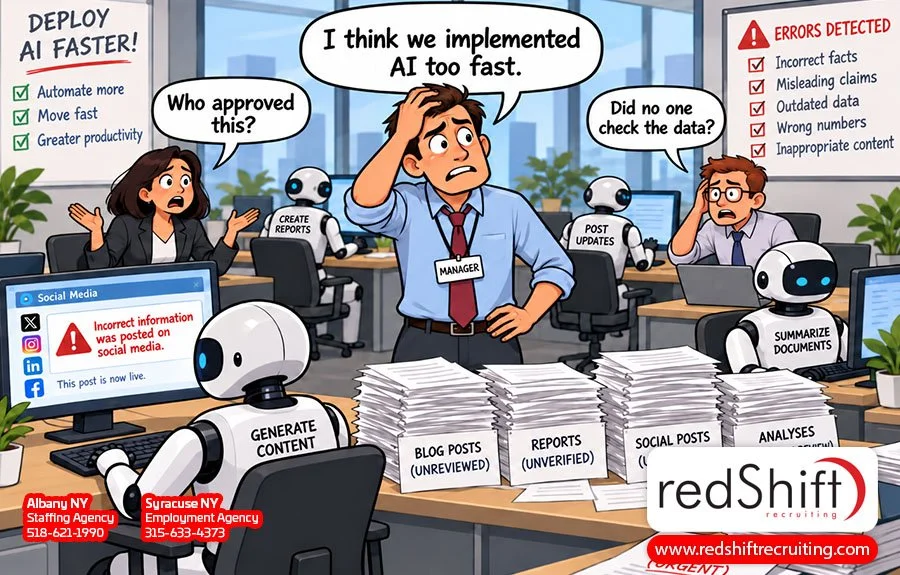
AI can take over or accelerate parts of a workflow, but plenty of responsibilities still depend on human capabilities and ownership. That is especially true when the work requires:
judgment or final decision-making;
accountability for the outcome;
company or customer context;
handling exceptions or unusual situations;
accuracy, quality control, or verification;
privacy, confidentiality, or regulatory compliance;
safety-sensitive or higher-risk decisions;
relationships, trust, or direct human interaction;
problem-solving or specialized skills.
Sometimes the limitation is the technology. In other cases, an AI application may be capable of completing a task, but the responsibility still belongs with a person.
An AI-powered customer service tool, for example, may be able to respond to a billing dispute, but an employee may still need to be involved when the situation requires a policy exception, knowledge of the customer relationship, or discretion about the best resolution. An AI application may be able to draft a compliance document, but accuracy requirements, privacy concerns, professional standards, company policy, or regulatory requirements may still make a human review necessary before the document is used. Trust is another important factor: just because an AI agent can complete a task faster doesn’t mean removing the person from the process will produce a better outcome.
When assessing whether a particular job opening still needs to be filled, employers should also watch for work that has changed hands rather than been absorbed by AI. An open position can start to look less necessary when managers pick up its responsibilities, senior employees cover work outside their normal roles, coworkers absorb additional tasks, or less-visible work is delayed or dropped. In those situations, what seems like increased efficiency may partly reflect workload redistribution rather than a reduced staffing need.
When employers separate the work AI can handle from the responsibilities that still need human ownership, the next question is whether the position itself still looks the same.
Has AI Changed the Position You Need to Fill?
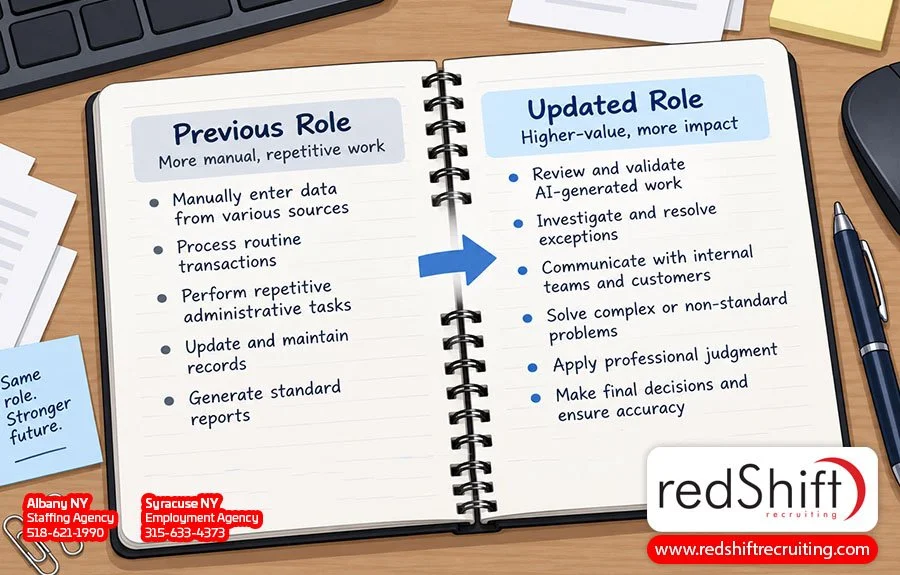
AI may change what a role looks like day to day without eliminating the need for a person altogether. As certain rules-based and manual tasks become easier to automate or accelerate, employees may spend more time reviewing AI-generated output, handling exceptions, communicating with clients or customers, applying human expertise, and solving more complex problems. Working with AI may also become part of the role itself.
These changes can shift the technical skill requirements employers look for and, in some cases, make AI skills part of the job requirements. The World Economic Forum's Future of Jobs Report 2025 found that 62% of respondents expected to focus on hiring people who are able to work with AI, while another 47% planned to transition employees from roles disrupted by AI into alternative positions.
Not every employer needs an AI specialist and not every job requires advanced AI literacy, but the numbers do suggest that AI adoption can change the skill mix a particular job requires without eliminating the need for the job itself. For an employer with an open position, the practical question is whether the existing job description still describes the person the business needs. AI may change who you hire without changing whether you hire.
What Should You Do With the Hiring Need Now?
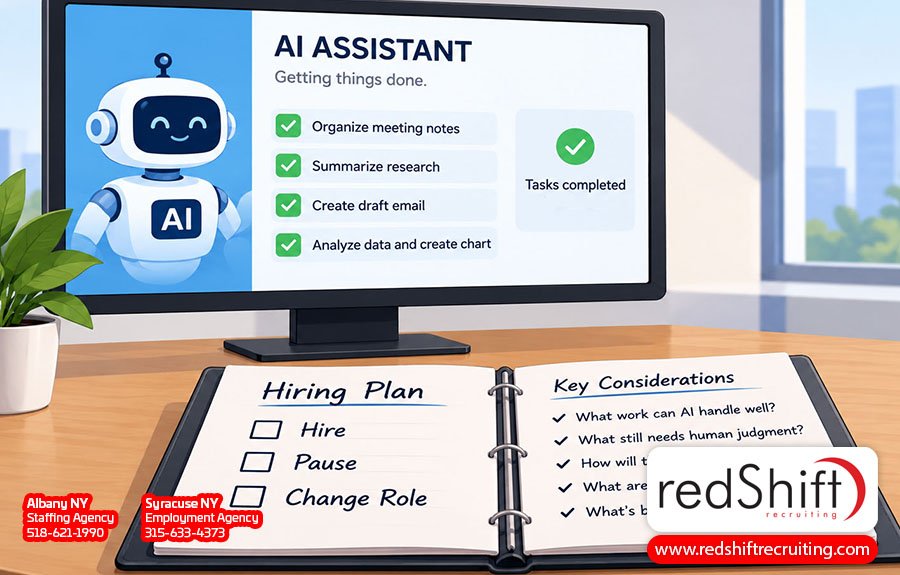
Once you've identified what AI has actually changed, decide what that means for the open position. Depending on the work that remains, that may mean moving ahead with the original hire, changing the role, covering the work another way, or deciding that additional headcount is no longer necessary.
Hire as Planned
Hiring still makes sense when necessary work remains, the current team can't absorb it, and AI hasn't reduced the workload enough to close the gap.
Observe how your team functions while the position remains open. Operational problems like missed deadlines, growing backlogs, slipping service or quality, low morale, and employees consistently taking on extra work can all indicate the department still needs additional help.
Pause Briefly
A short pause can make sense when the position itself is actively changing or when the employer expects to resolve a specific question soon. Perhaps a new AI tool is still being tested, the division of work between employees and AI isn’t clear, or the employer needs a little more evidence before deciding how the job description should change.
The important part is having a valid reason for the pause and a set point at which the decision will be revisited. Waiting for a defined test or implementation period to finish is different from leaving a position open indefinitely because continued AI development might eventually make the role unnecessary.
Adjust the Role or Skills
Sometimes AI changes the work without reducing the need for another employee. When that happens, adjust the position to reflect the responsibilities that remain and the skills needed to handle them well.
A role may now involve less time on routine tasks and more time reviewing AI-generated work, handling exceptions, communicating with customers or coworkers, solving problems, or making decisions. The employee may also need to know how to work with AI effectively as part of the job. Updating the responsibilities and requirements before hiring helps ensure you're recruiting for the role the company needs now, rather than the version that existed before the AI era.
Train or Redeploy Existing Employees
Redeployment may make sense when current employees have enough room in their workloads, the remaining responsibilities fit reasonably well with their existing abilities, and new skills can be learned without simply shifting too much work onto someone else.
Moving work internally can solve a staffing need when the people taking it on have the time, skills, and support to do it well. The important question is whether employees can take on those responsibilities sustainably, rather than whether they have managed to cover them temporarily.
Use Temporary or Contract Support
When the business needs help now, but the longer-term workload is still uncertain, temporary or contract hires can offer short-term support without committing to a long-term decision.
This can be useful when responsibilities are still shifting, an AI implementation is being evaluated, or the employer knows the work needs coverage but isn't sure what the permanent position should look like. Flexible staffing options give the team time to learn more about the actual need while keeping the current workload from falling behind.
Reduce or Cancel the Planned Hire
Sometimes AI really does remove enough work that additional headcount is no longer justified. That possibility should be evaluated as seriously as the other options.
The World Economic Forum's Future of Jobs Report 2025 found that 41% of surveyed employers expected to downsize their workforce as AI's capabilities improve. That doesn't mean AI-driven job displacement is the expected outcome for every employer, but it does show that AI can genuinely reduce labor demand in some circumstances.
However, don't forget that canceling a planned hire also affects the people already doing the work. When the remaining responsibilities are redistributed, employers should consider whether current employees can absorb them without sustained overload, lower morale, lost institutional knowledge, or problems with service and quality. Employers should also consider what repeatedly removing more junior roles could mean for their future talent pipeline, since employees often build the context, experience, and judgment needed for more complex work by starting with entry-level responsibilities. Avoiding the cost of a new hire may look like a savings on paper, but those savings can quickly lose their value if the decision leads to burnout, turnover, mistakes, missed work, or declining performance.
For an individual hiring decision, focus on what's actually happened inside the company, rather than theories about what AI could make possible. Has AI consistently reduced employees' workloads? Is the remaining work already being handled sustainably? A planned hire can reasonably be reduced or canceled if the answers support it, but that shouldn't be the automatic conclusion simply because the organization has begun to adopt AI tools.
Should Future AI Technologies Change Today's Hiring Plan?
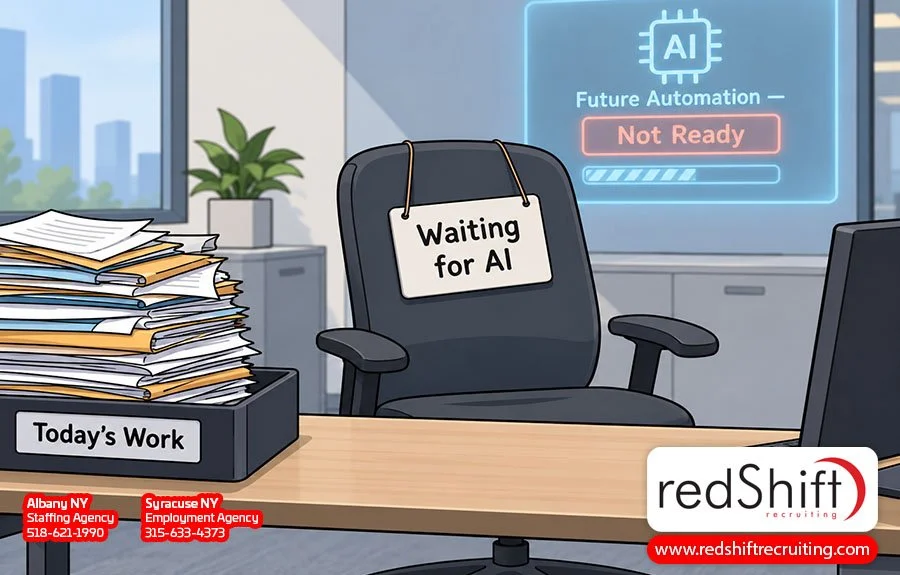
There is an important difference between what AI can reliably handle today and what an employer expects it may handle in the future. The rapid progress of large language models, machine learning, natural language processing, and other AI technologies makes it easy to assume that a limitation seen today will disappear soon, but the timing and business impact of those advances are much harder to predict.
Tasks that are piling up, deadlines that are slipping, or employees who are consistently covering additional responsibilities need a realistic solution now. That may be a permanent hire, temporary support, redistribution of work, a process change, or another practical response.
Employers can revisit staffing plans as technology improves and AI use expands. What they should avoid is leaving important work uncovered because a new AI tool might eventually make the position unnecessary. Potential AI-driven automation in the future cannot complete the work sitting unfinished today.
Quick Check: Should Artificial Intelligence Change Your Hiring Plan?
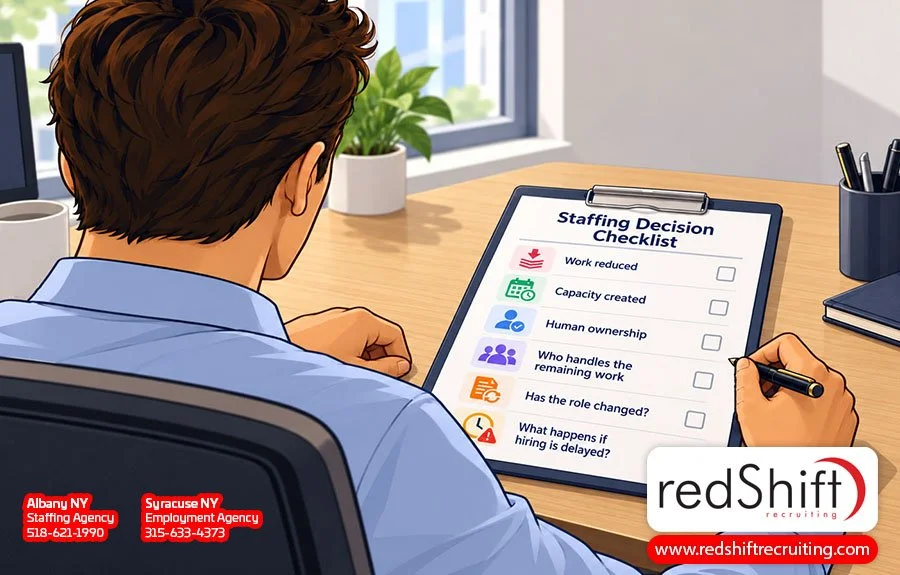
Before changing a planned hire because of AI, work through these questions:
What work has AI actually reduced or eliminated?
How much time for other high-value tasks has that created?
What work still needs a human to take responsibility for it?
Who is handling that work currently?
Has the position changed, or has the need for a person actually declined?
What happens if the hire is delayed?
Those answers may support hiring as planned, changing the role, redeploying employees, using temporary or contract support, pausing for another defined reason, or reconsidering the staffing need. More than one response may also make sense at the same time, such as revising a role while using contract support during the transition.
Once you understand what AI has actually changed, you can make the better hiring decision around the work your business and your employees still need covered.
Frequently Asked Questions
Does This Mean Employers Should Replace Employees With AI?
No. Employers should look at whether AI use has actually removed enough work to change staffing needs, rather than assuming that adopting new technology automatically means fewer people are necessary. In many AI-enabled workplaces, the more realistic model is AI handling or accelerating routine tasks while employees continue to provide judgment, accountability, context, relationships, and oversight.
What Happens When AI Saves Time but Doesn't Eliminate Enough Work to Reduce Headcount?
The time employees save can be used to address backlogs, improve service, support growing demand, take on higher-value work, or give overloaded employees more sustainable workloads. AI creates value in more than one way, and greater efficiency doesn't have to translate directly into fewer employees. Employers should look at what additional work the business can accomplish before treating every productivity improvement as a headcount reduction.
Could AI Create New Hiring Needs Even as It Automates Other Work?
Yes. As AI adoption changes existing roles, employers may need people with stronger AI literacy, data analysis, technical oversight, or other new skills. Some existing jobs may evolve while entirely new jobs or AI-related jobs emerge to support, manage, review, or apply the technology. New roles are also emerging around the human qualities and responsibilities AI cannot fully replicate.
How Long Should an Employer Test AI Before Changing Staffing Levels?
There is no universal testing period because the right timeline depends on the role, workload, and AI application involved. Employers need enough real-world experience to see whether the tool performs consistently, how much review it still requires, and whether employees can use the technology effectively across both routine and less predictable situations. Early results can be useful, but they may not reflect how the tool will perform once AI deployment expands across the team’s full workload.
Should Small Businesses Approach AI Staffing Decisions Differently From Large Companies?
Small businesses often have less room to redistribute work because a single employee may cover several responsibilities. Automating a few manual tasks can free up valuable time without eliminating enough work to remove the role, and there may be fewer coworkers available to absorb the tasks that remain. Gradual AI adoption, combined with temporary support or changes to the role where needed, can give smaller employers more flexibility while they learn what the technology can reliably handle.
Conclusion: What Does AI Mean for Your Hiring Plan?
AI can reduce workloads, increase the time available for high-value tasks, and change the skills a role requires. In some cases, those changes may actually reduce the need for an additional hire. In others, AI is more useful as a tool that helps employees do their jobs better than as a reason to leave a new position unfilled. Some responsibilities still call for human judgment, accountability, relationships, or expertise and should not be handed over completely to AI automation, even when these tools are capable of assisting with them. As AI use continues to evolve, employers can revisit their staffing plans based on what the technology is actually accomplishing, what work still needs a person behind it, and what their teams need to keep the business running well.
Need Help Hiring?
Whether you need permanent talent, temporary support, or help filling a role that has changed, redShift Recruiting can help you find the right person for the work you need done.

Article Author:
Ashley Meyer
Digital Marketing Strategist
Albany, NY
from Career Blog: Resources for Building a Career - redShift Recruiting https://www.redshiftrecruiting.com/career-blog/can-ai-reduce-staffing-needs
via redShift Recruiting


Comments
Post a Comment