Is Technology Making Hiring Harder? Why Better Tools Still Depend on Human Judgment
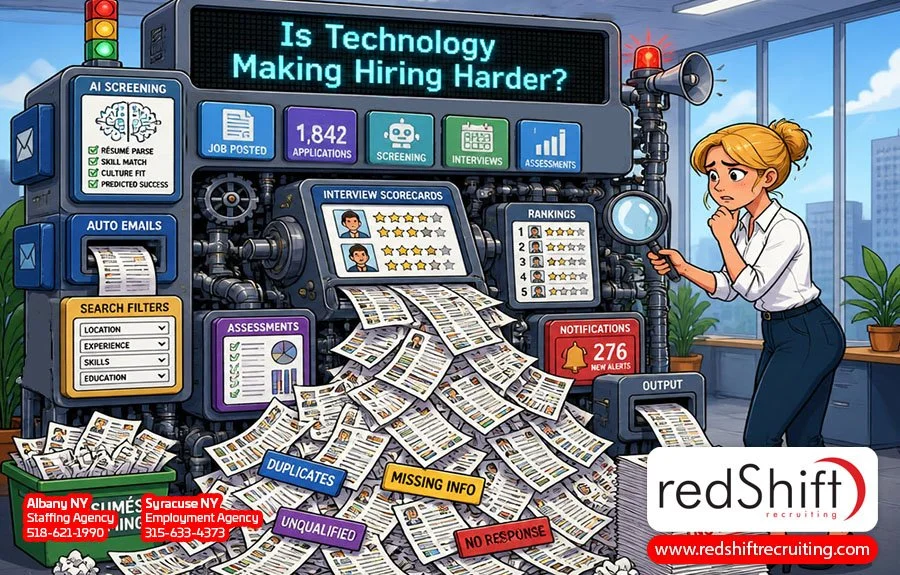
You only need to spend a few minutes scrolling the news or social media to see another announcement about a new or improved technology promising to make work faster, easier, or more efficient. Hiring has been no exception, as artificial intelligence and other AI tools have transformed how organizations source candidates, advertise job listings, and manage the recruitment process. They have also changed how people search for opportunities in today's job market, making it easier than ever to find job openings and apply.
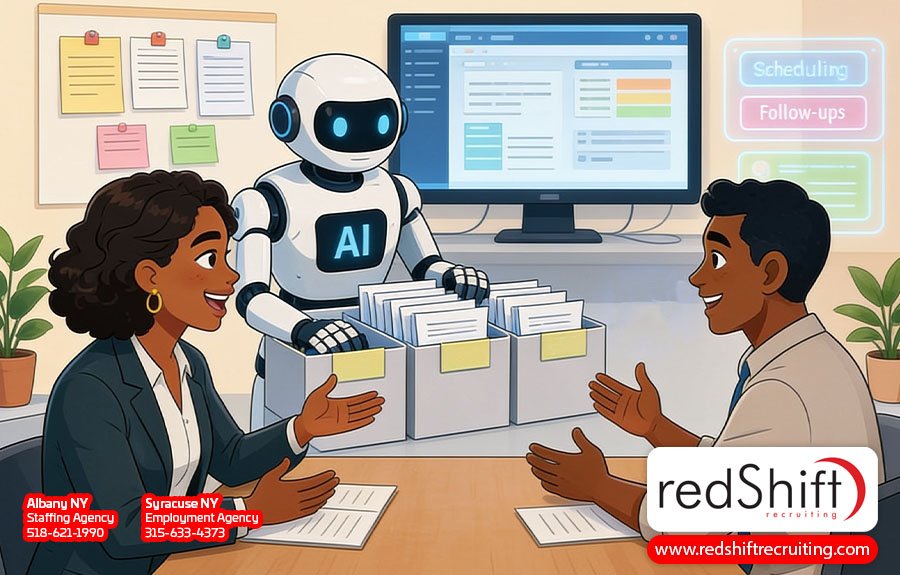
The expectation on both sides is that these tools should make hiring easier. Candidates can apply to dozens or even hundreds of positions in a fraction of the time, sometimes using AI-assisted resumes and cover letters tailored to each opportunity. Meanwhile, employers and recruiters can search resumes in seconds, automate interview scheduling, filter applications by skills, and streamline repetitive administrative work.
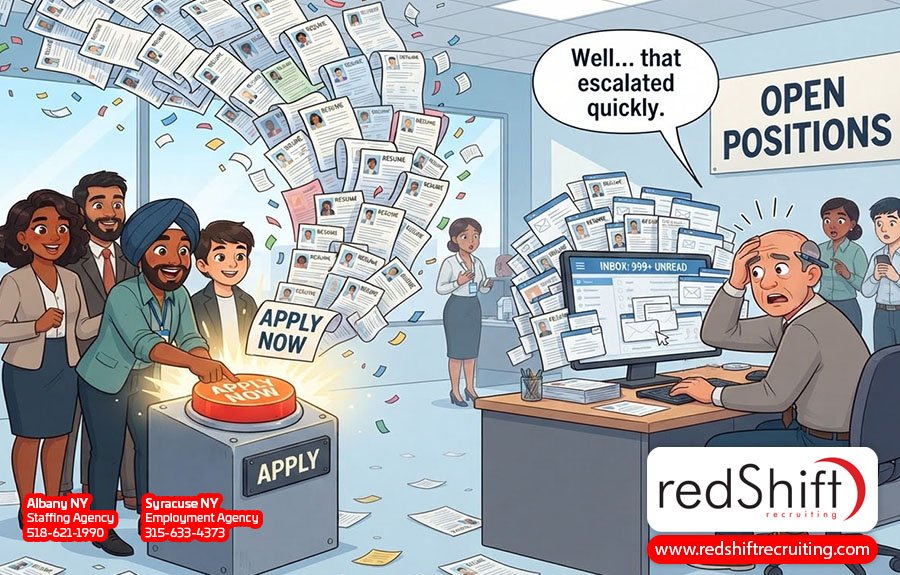
Yet despite better tools, hiring often feels more frustrating than ever. Candidates describe fake job listings, hiring scams, lengthy interview processes, and submitting hundreds of applications through online job boards without ever hearing back. Employers tell a different version of the same story. A hiring manager may be overwhelmed by hundreds of applications for a single opening, many from applicants who clearly aren't qualified for the role, while still managing interviews, internal approvals, ongoing candidate communication, and the rest of their day-to-day responsibilities. On top of the volume of work, AI-generated resumes and cover letters can make applications look increasingly similar, making it harder to identify genuine strengths or point to the candidates who truly stand out.
So, all this raises the question: is technology making hiring harder? If today's tools are more powerful than ever, why doesn't the hiring process always feel more effective?
Technology Has Changed Hiring—But Not Always the Hiring Process
It's easy to assume that if technology makes the hiring process more efficient, it should also make it more effective. But efficiency and effectiveness aren't the same thing.
Technology has unquestionably improved many administrative and operational aspects of recruiting. Employers can search resumes in seconds, automate interview scheduling, streamline administrative tasks, and use AI to assist with everything from writing job descriptions to communicating with applicants. Meanwhile, candidates can identify opportunities, prepare for interviews, expand their professional network, and navigate job boards far more efficiently than they could just a few years ago.
There's no question these tools have value. By reducing repetitive administrative work, they allow hiring teams to spend more time on the most important hiring activities: the ones that require conversation, evaluation, and decision-making. At the same time, candidates can use a range of tools to discover relevant positions, tailor application materials, and apply more quickly than ever before, significantly reducing some of the most time-consuming parts of a job search.
Ideally, those efficiencies would create more time that could be spent creating a hiring process that feels more responsive, more personal, and ultimately more effective for everyone involved. But that's not what many people are experiencing.
The problem is that improving individual tasks doesn't automatically improve the hiring process itself. For example, a scheduling tool can schedule interviews, but it can't shorten a bloated recruitment procedure that requires six or seven rounds of approvals. A lengthy, confusing job description is unlikely to attract many applicants, no matter how quickly the system posts it. Automated emails can acknowledge an application was received, but they don't replace timely, meaningful communication between humans. And an AI-powered ATS can help manage applications more effectively, but may also filter out qualified candidates due to overly strict criteria.
Often, technology amplifies the process that's already in place. That means organizations with thoughtful hiring practices often become more efficient, while organizations with inconsistent communication, unnecessary complexity, or poorly designed hiring workflows frequently find those same problems only become more noticeable as hiring moves faster.
More Information Doesn't Always Mean Better Hiring Decisions
Beyond improving efficiency, technology has also transformed the amount and quality of information available throughout the hiring process. Employers can search resumes, compare candidate profiles, run a report, organize applications, review assessments, and summarize qualifications in seconds. Candidates have similar advantages, using AI and other technologies to research employers, prepare for interviews, optimize resumes, understand salary trends, and access countless resources offering career advice and job search strategies.
The expectation is straightforward: the more information employers and candidates have about each other and the labor market, the easier hiring should become.
In many ways, technology has delivered on that promise. AI can help prospective employees present their experience more clearly, making it easier for someone with valuable skills but weaker writing abilities to explain their qualifications. And on the employer side, AI-supported applicant tracking systems can quickly identify resumes with relevant experience, while assessments and other tools provide hiring managers with additional information to evaluate candidates.
The challenge is that more information doesn't automatically translate into better decisions.
Yes, technology has made it easier to gather, organize, and analyze information, but that information still has to be interpreted. An employer may have a wealth of data points in the form of resumes, assessments, AI-generated summaries, and interview notes for hundreds of applicants. But if the hiring process isn't designed to identify what matters most—or the person using those tools doesn't understand how to interpret the information effectively—more data simply becomes more noise.
Technology has also changed how employers use the information they receive to evaluate candidates. AI-generated resumes, optimized cover letters, and AI interview preparation tools can all help candidates communicate more effectively, but they can also make applications look increasingly similar. A polished resume may do a better job of describing someone's experience, but it doesn't necessarily make it easier to distinguish authentic capability, long-term potential, or the qualities that matter most once someone is on the job.
All this means that technology has become remarkably good at collecting, organizing, and presenting information. But information alone doesn't answer the questions employers ultimately need to answer.
And that's because hiring has never been fundamentally an information problem. It's a judgment problem.
Hiring Has Always Been a Judgment Problem
Hiring is a business decision that asks people to predict the future using incomplete information. Financial analysts use their expertise to assess economic conditions, consumer demand, and investment risk to help organizations make better financial decisions. Although no one can predict the market with certainty, their experience allows them to make more informed recommendations than the average investor. Hiring professionals face a similar challenge: using their expertise to go beyond a list of qualifications and try to understand how a worker is likely to perform, communicate, adapt, and grow in a new environment.
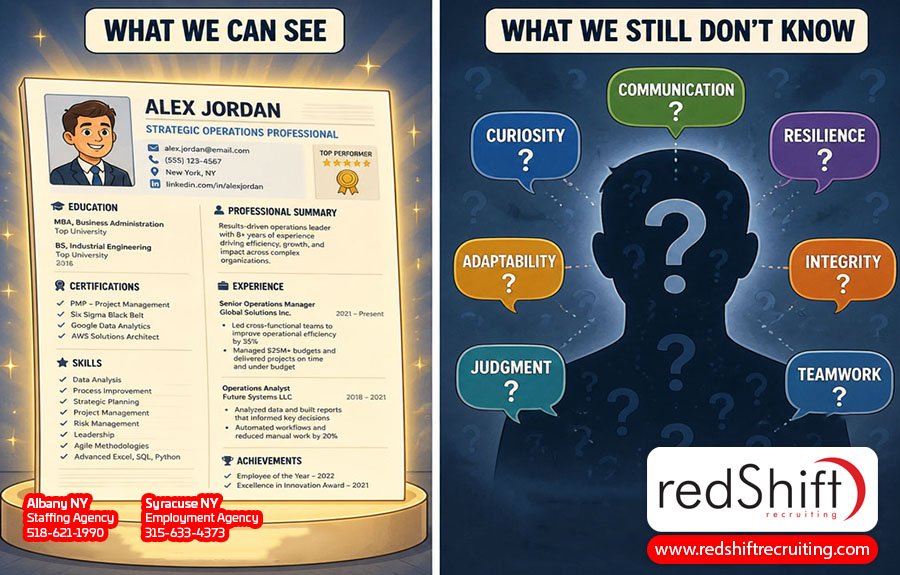
Of course, those questions can never be answered with complete certainty before someone is hired. Regardless of how polished someone's resume is, how well they perform in an interview, or how perfectly they complete an assessment, no recruiter, hiring manager, or AI system can know for certain whether a new hire will be successful. Will they be able to do the job effectively, develop new skills, or adapt when priorities shift? How will they respond to feedback, collaborate with other employees, or react when a difficult project doesn't go according to plan? Will they even still be here in a few months?
Those are questions about future performance, not past accomplishments. Resumes, interviews, assessments, and references can all provide valuable information to help employers make good hiring decisions. They highlight education, work history, certifications, accomplishments, and the skills someone has developed throughout their career. But while these are all valuable data points, they ultimately are just records of what someone has done. The question hiring tackles is what they are likely to do next.
The reality is, even resumes that appear nearly identical can represent very different experiences. Two candidates may list the same certification, the same job title, or the same project, yet one may have led the work while the other simply participated. That distinction may not be clear until someone begins to dig deeper.
The same is true during interviews. Prepared answers certainly have value, but many of the most meaningful insights emerge after the scripted response. Understanding why someone made a career change, how they approached a difficult challenge, what they learned from a mistake, or how they earned the trust of previous teammates often requires time spent talking and listening, asking thoughtful follow-up questions, and exploring experiences in greater depth.
Every hiring decision is ultimately an exercise in managing uncertainty. People are complex, organizations change, and circumstances evolve. No hiring process—regardless of how much technology supports it—can eliminate that uncertainty completely.
The goal has never been perfect certainty; it's making the best possible decision with the information available.
So that raises one final question: if better technology and more information aren't enough on their own, what actually improves hiring?
Building a Better Hiring Process for the Modern Job Market
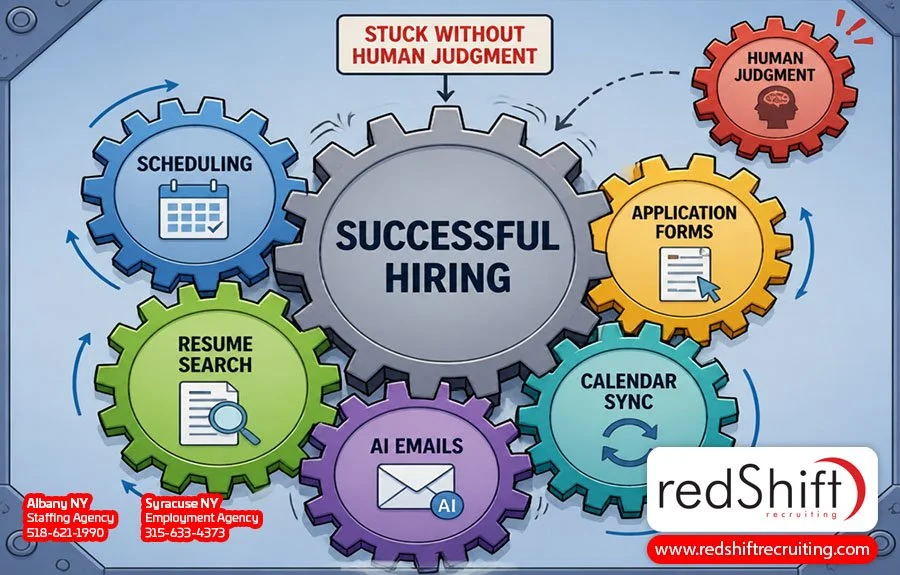
Technology has changed recruiting dramatically, but it hasn't changed what good hiring has always required. Organizations that build strong recruitment strategies use technology to support thoughtful processes, meaningful conversations, and informed decision-making, not just speed things up.
Building a better hiring process with technology starts with deciding where these tools add the most value. AI and automation excel at repetitive administrative work such as scheduling interviews, organizing applications, summarizing information, and other time-consuming tasks. Those efficiencies should create more time for the parts of hiring that benefit most from human involvement: defining the role, asking thoughtful interview questions, building relationships with candidates, and making well-informed hiring decisions.
Just as importantly, organizations should periodically evaluate the process itself rather than simply adding new tools. If hiring managers are struggling to keep up with the candidate pipeline while the candidates themselves regularly wait weeks for updates, another AI tool probably won't solve those problems. Streamlining unnecessary steps, improving communication, clarifying decision-making responsibilities, and respecting candidates' time often have a greater impact than simply adding more technology.
Experience also matters. If effective hiring is fundamentally a judgment problem, then improving hiring means helping people make better judgments. In almost every skilled profession, expertise doesn't eliminate uncertainty—it simply allows a professional to interpret complex data points more accurately. For example, a data scientist and a business leader may have access to the same information, but a data scientist has the specialized training and experience to identify meaningful patterns, recognize important relationships, and draw insights that someone without that expertise might overlook. Similarly, experienced hiring professionals can't guarantee every hire will succeed, but they have spent years interviewing candidates, evaluating resumes, observing hiring outcomes, and learning from both successful and unsuccessful decisions. That experience helps them ask better questions, recognize meaningful patterns, and make stronger decisions than someone who only hires occasionally.
Finally, recognize that there is no one-size-fits-all recruiting strategy. Hiring expectations differ across every industry, sector, and company, while available talent changes as the labor market, broader economic conditions, employer demand, and employment trends evolve. Hiring for job openings in the tech industry, such as software development or cloud computing, requires different approaches than hiring in manufacturing, accounting, healthcare, or many other industries.
So, is technology making hiring harder? The answer is both yes and no. Technology can make hiring feel harder when it amplifies inefficient processes, overwhelms employers with more information than they can effectively interpret, or replaces meaningful human interaction. But when it's used intentionally to support thoughtful processes and informed decision-making, it becomes one of the most valuable tools available to employers and candidates alike.
Ultimately, the challenges of hiring won't be solved simply by making individual tasks faster or adopting more technology. The organizations that hire most effectively in the future will be those that use technology intentionally to automate routine work, strengthen rather than replace human judgment, and build hiring processes that are efficient, thoughtful, and genuinely centered on people.
Frequently Asked Questions
How Can Employers Improve the Hiring Process Without Sacrificing Efficiency?
Improving efficiency doesn't have to come at the expense of the candidate experience. Many employers find the biggest gains come from simplifying unnecessary steps, clearly defining needed skills, reducing delays between interviews, and using technology for the administrative heavy lifting rather than replacing valuable conversations. If your team feels like it spends more than half the day reviewing resumes, coordinating interviews, or completing other repetitive administrative tasks, there may be opportunities to automate those activities and free up more time for communication, relationship-building, and decision-making. Even small changes can improve the quality of the hiring process for both employers and candidates.
Take some time to assess how your recruitment efforts have functioned over the past year or two:
Have interview rounds gradually increased without improving hiring outcomes?
Are candidates waiting too long for updates?
Are hiring managers spending more time reviewing applications but feeling less confident in their decisions?
Has technology streamlined the process, or has it simply accelerated existing bottlenecks?
The goal shouldn't simply be to move faster; it should be to create a hiring process that helps people make better decisions.
How Can Employers Create a Better Candidate Experience with AI Tools?
Used thoughtfully, AI can drastically improve the candidate experience by keeping applicants in the loop. Tools that automate repetitive tasks, instantly acknowledge applications, and answer routine, late-night questions prevent candidates from feeling like their application disappeared into a black hole.
The best results come when technology acts as a responsive bridge. When AI handles the immediate administrative updates, it ensures candidates never face weeks of silence, while leaving hiring teams with more energy to dedicate to personalized, high-value communication later in the process.
What Makes a Hiring Process Feel Human in the Modern Labor Market?
One reason so many people feel the hiring process is impersonal today is that technology often replaces human interaction instead of creating more time for it. Most people don't expect constant updates or immediate job offers, but they do appreciate honest communication, realistic timelines, and being treated with respect. A hiring process feels more human when employers explain expectations, keep candidates informed, and take time to talk with applicants rather than relying entirely on automated communication.
Even when someone isn't selected, a thoughtful experience shapes how they view a company, its culture, and its employment practices. Every interview is part of the organization's story, and candidates often remember how they were treated long after the process ends.
How Can Employers Identify the Best Candidate When So Many Use AI Tools?
As AI tools become more common, polished resumes and cover letters are no longer enough to distinguish candidates. Some applicants may even stuff their resume with keywords or rely heavily on AI to optimize their application materials. While those tools can improve presentation, they don't replace genuine experience or potential.
This is why more recruiters and hiring managers are shifting to skills-based hiring, prioritizing proven skills and abilities over degrees or job titles. Thoughtful interviews, follow-up questions, work samples, references, and conversations about how someone approached a difficult project can reveal strengths that aren't obvious on paper. Focus on finding the strongest fit—not the strongest resume.
How Can Organizations Use AI Tools to Support Better Hiring Decisions?
AI is a valuable tool for organizing information, identifying patterns, and supporting decision-making, but it shouldn't become the decision-maker. Technology can highlight candidates with relevant experience, summarize information, and help hiring teams evaluate larger applicant pools more efficiently. However, without regular auditing, AI tools can also reproduce bias and errors, ultimately undermining the company's recruitment strategy.
The strongest hiring decisions combine technology with professional judgment. As organizations continue adapting to changing working conditions, evolving demand, and new hiring challenges, AI works best when it helps people make informed decisions—not when it replaces the experience and judgment that good hiring has always required.
Conclusion: Technology Is a Tool, Not the Solution
Technology has transformed hiring in remarkable ways. It has streamlined administrative work, improved access to information, and helped employers and candidates navigate a rapidly changing industry. Whether recruiting for a tech job or a manufacturing role, organizations have more tools than ever before to identify talent and streamline the recruitment process.
The point isn't that technology has made hiring worse. In many cases, it has made it significantly better. But better tools alone can't solve problems that have always depended on human experience. As competition for top talent continues to increase and many employers adapt to changing business priorities, the businesses most likely to succeed in the future will be those that use technology to support—not replace—the people responsible for understanding candidates, making thoughtful hiring decisions, and building stronger workplaces.

Article Author:
Ashley Meyer
Digital Marketing Strategist
Albany, NY
from Career Blog: Resources for Building a Career - redShift Recruiting https://www.redshiftrecruiting.com/career-blog/is-technology-making-hiring-harder
via redShift Recruiting



Comments
Post a Comment