When Entry-Level Jobs Don’t Train Workers Anymore
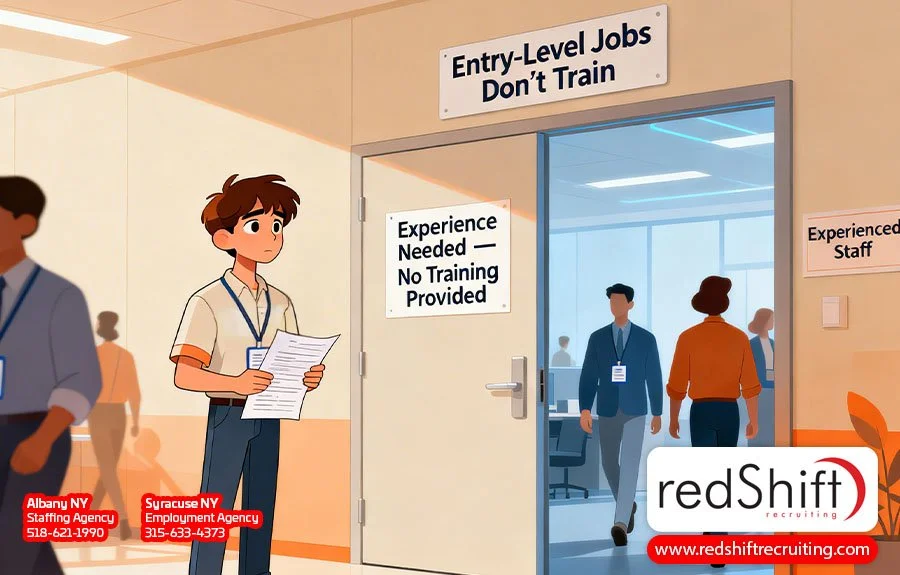
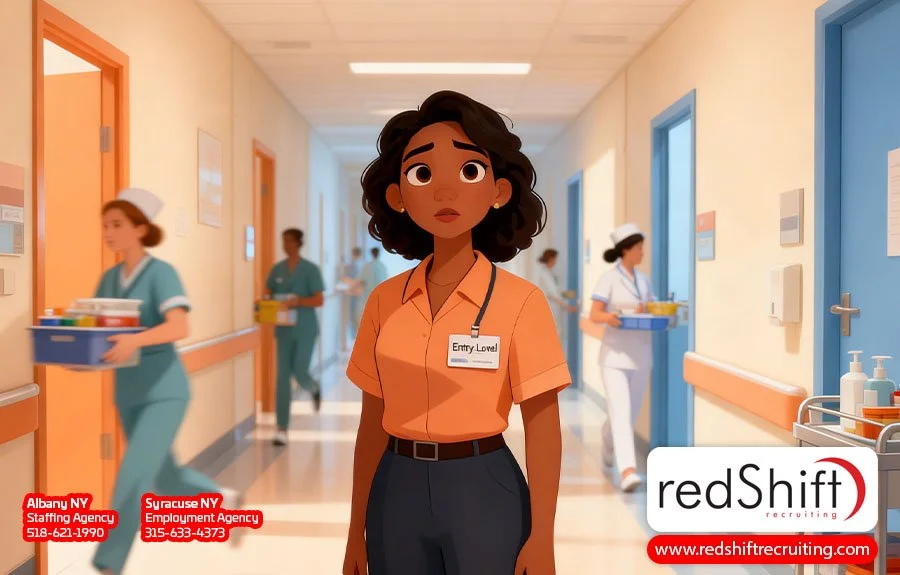
How do entry-level workers become senior workers? Historically, the answer was straightforward: they came up through the ranks. Organizations hired out of high schools and colleges, invested in training, and gave new workers time to develop, gradually increasing responsibility while learning through observation, repetition, and mentorship. Their investment paid off in the form of experienced, promotable employees who could sustain operations and eventually fill more advanced roles.
That pathway still exists on paper. But in practice, it's eroding.
Several factors have contributed to this. Today's workers change jobs more frequently, formal apprenticeship models have largely disappeared, and the rise of contract and gig work has shifted responsibility for development away from employers entirely in some cases. But one of the more overlooked drivers is a fundamental change to the nature of entry-level work itself. Operational pressure, safety constraints, and increasingly narrow job designs have quietly stripped away the conditions that once allowed new workers to develop through experience.
In a previous article, we examined how constrained, understaffed teams are reshaping entry-level hiring, resulting in roles that were once true starting points now expecting candidates to arrive ready to contribute. This article looks beyond hiring to consider what happens when the work itself no longer supports learning. Because when entry-level jobs don't train workers, the staffing problem compounds: fewer people grow into advanced positions, internal pipelines thin out, and labor shortages become harder to solve.
When Work Moves Too Fast to Train Entry-Level Employees
In many industries, the pace of work has changed in ways that are easy to feel, but harder to step back and analyze. In today's workplace, teams are often expected to maintain the same level of productivity with fewer workers, tighter timelines, and a smaller margin for error. For managers, that creates a constant balancing act: keep things moving, or slow down to train people.
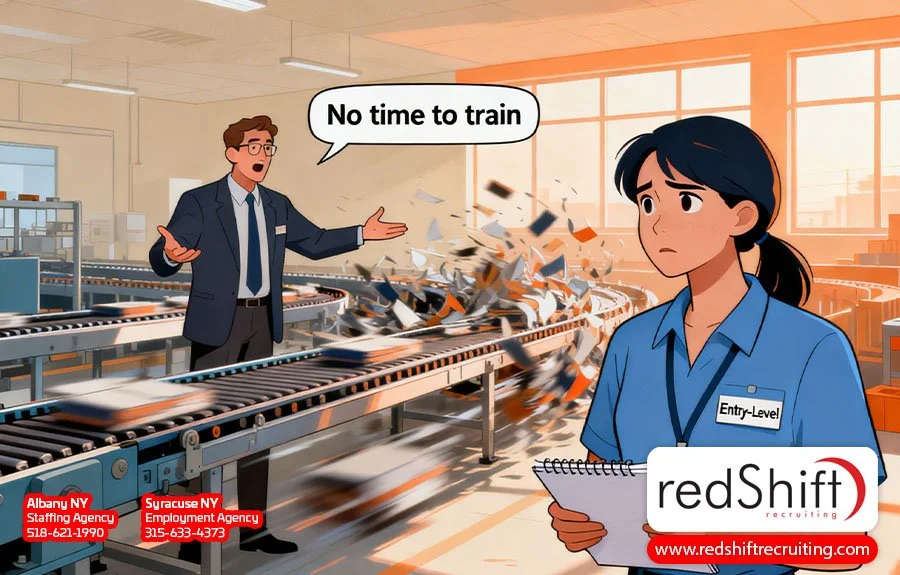
In practice, output usually wins. This isn’t always a deliberate decision to avoid spending money on training—it’s often a tradeoff made under pressure. While some employers may be reluctant to invest resources in training programs for inexperienced workers, for many, it’s not just a question of willingness—it’s a question of whether those resources are realistically available in the moment. When teams are already stretched thin, even small slowdowns can ripple across operations, affecting deadlines, customers, and overall business performance. For senior employees focused on maintaining basic coverage, training co-workers often becomes harder to prioritize.
As a result, professionals of all experience levels are often expected to emphasize task execution over skill development. Opportunities for shadowing and mentorship become harder to obtain, hands-on learning is more limited, and new entry-level employees have less room to make mistakes and improve.
This leads to many "entry-level" job postings requiring experience and new hires expected to hit the ground running with little support or guidance compared to the past. The job descriptions haven't officially changed, but the environment no longer supports actual entry-level talent. In many cases, the expected timeline for new hires to become productive has also shortened, making gradual skill development challenging when immediate output is required. Put simply, jobs that once allowed workers to learn while contributing now often require them to contribute before they have learned.
For early-career talent, that can feel like being asked to keep up without ever being shown how. For hiring managers, it can feel like the only viable candidates are those who already have experience.
And across the labor market, that tension starts to compound.
High-Risk Environments Leave Little Room for Training
Speed is one constraint. Risk is another.
In many operational settings, the cost of mistakes has increased—whether that’s safety risk, compliance exposure, or operational disruption. In these environments, the idea of allowing inexperienced employees to learn through trial and error becomes much harder to support.
In healthcare, for example, even small mistakes can have serious consequences for patient care, while in manufacturing, errors can impact safety, equipment, or production flow. In logistics, a single misstep can slow down an entire process, delaying orders and disrupting operations. And in regulated environments like finance or pharmaceuticals, errors can create compliance issues, audit exposure, or regulatory penalties.
Across these types of environments, the margin for error is limited. And that changes how organizations approach training. Instead of gradually building capability on the job, many roles now require a baseline level of hands-on experience from day one. There’s less room for observation, fewer chances to “learn by doing,” and more pressure on new hires to perform immediately.
From an operational standpoint, this makes sense. When the risk of mistakes is high, relying on inexperienced workers becomes more difficult to justify. But there’s a downstream effect.
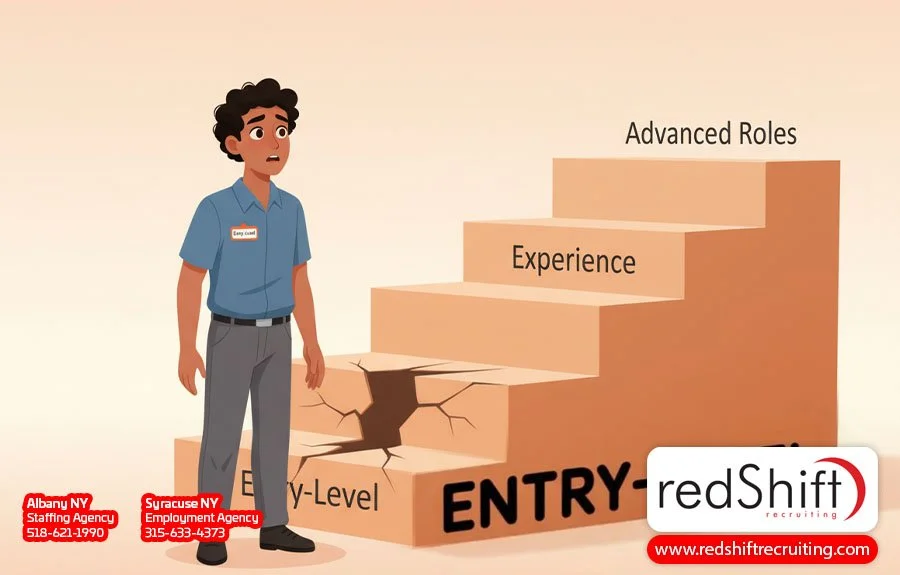
When entry-level roles are shaped by environments where errors are costly, expectations are strict, and compliance requirements are high, they stop functioning as effective training grounds, even if employers want to support employee development. This is especially challenging for early-career workers trying to build skills. Without opportunities to practice, observe, and improve, it becomes harder to gain the experience needed to move forward in their career. For some, just getting their foot in the door becomes a major hurdle, as they find themselves in an ongoing cycle where experience is required to access the very roles that would allow them to build it.
Unchecked, this dynamic contributes to a broader shift in the talent pipeline: fewer roles are able to provide professional development opportunities. Fewer workers develop meaningful experience. And the gap between what roles require and what candidates can offer continues to widen.
Repetition Doesn’t Always Build Advanced Skills
But even in roles where speed and risk are less dominant, another challenge emerges: not all job descriptions support career growth. In some entry-level roles, the work is structured around narrow routines—repetitive handling, standardized tasks, or physically demanding activities that don’t change much. These roles may be essential to operations, but they don’t always create opportunities to advance. Workers can spend months, or even years, performing the same set of responsibilities without exposure to broader workflows or decision-making. They become more efficient at the task itself, but their overall ability doesn’t change in a meaningful way.
In some situations, workers may appear experienced on paper, but have limited exposure to the broader skills required to grow into more senior roles. From a distance, it may look like experience is being gained, but in reality, their skill set is limited to a narrow range of tasks without opportunities to take on new responsibilities or develop as professionals.
This is an important distinction in today’s job market, where years of experience are often taken at face value as a sign someone can step into a role and perform it effectively—even though that experience is restricted to repetitive assignments. But not all experience carries the same value: some roles develop adaptable skills, while others simply reinforce the same set of actions.
Learning Work vs Non-Learning Work
To make sense of all this, it helps to look at how work is structured. Tasks often fall into two categories: learning work and non-learning work. Learning work exposes individuals to a wider range of tasks and responsibilities over time, allowing for observation, mentorship, and gradual skill-building. Workers gain context, develop judgment, and build the kind of experience that supports long-term success. Historically, many entry-level roles were designed with this type of progression in mind, often supported by internships, on-the-job education, or structured onboarding.
In contrast, non-learning work is typically narrowly defined, focused on repetitive execution, and offers limited exposure to how the broader process or department operates. There is little opportunity to take on new responsibilities or build transferable skills, and job descriptions often emphasize efficient performance rather than career advancement.
As organizations prioritize speed, consistency, and risk reduction, fewer roles are designed with built-in progression in mind. The result is a disconnect between what students and graduates expect from early-career work and what many jobs actually provide.
Gradually, this changes the structure of the workforce development cycle. When fewer roles function as learning environments, workers struggle to move into more advanced positions. And that has implications not just for individual careers, but for how companies prepare for the future.
Why This Matters in the Context of a Labor Shortage
When entry-level jobs stop functioning as training environments, internal promotion pathways begin to weaken, external talent pools become smaller, and organizations have fewer options when they need to fill critical positions.
This creates a reinforcing cycle: Fewer training environments → Fewer experienced workers → Greater staffing pressure.
Across industries, the pressure shows up in different ways, but the pattern is consistent. Companies continue to look for candidates who are ready to contribute immediately in entry-level jobs, while fewer roles are actually building that readiness. It becomes harder to find the right person, not because potential doesn’t exist, but because fewer opportunities exist to develop it.
This dynamic also shapes how people experience the job market. Many candidates enter the workforce expecting to build skills on the job that they weren't able to learn in school. Instead, they often encounter roles that require experience but offer limited opportunity to gain it.
It’s a frustrating cycle for both employers and job seekers, reflected in candidate feedback, hiring challenges, and even broader research and survey data. Left unaddressed, the cycle tends to reinforce itself rather than correct over time. Even when organizations recognize this pattern, addressing it isn’t simple. Reintroducing training requires time, capacity, and short-term tradeoffs that many teams feel they can’t afford to make. The key point is this: a labor shortage becomes harder to address when the jobs themselves are not building the workforce.
Do Your Roles Develop Talent?
If entry-level jobs no longer function as learning environments, it may point to a deeper shift in how work is structured. When roles are designed around speed, consistency, or risk reduction, they often leave less room for new employees to build skills on the job. Over time, that can make it harder to develop the experience your organization depends on.
Talk With Our Team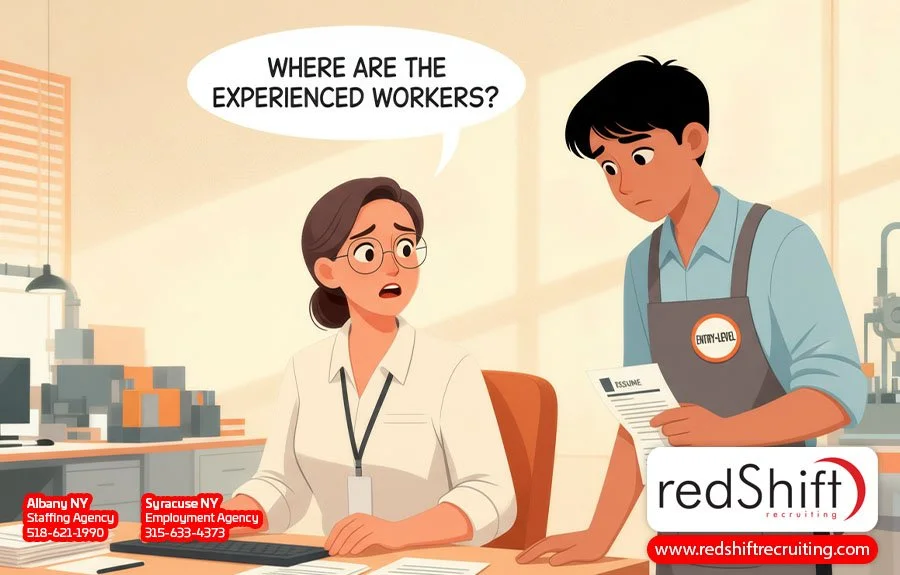
Frequently Asked Questions
Why Don’t Entry-Level Jobs Train People Anymore?
Many organizations still want to train people, but the structure of work has changed. Faster-paced environments, tighter staffing, and higher expectations mean there’s often less time and fewer resources available for training than in the past.
In many cases, the primary issue isn’t intent, but rather capacity. Teams are concentrated on maintaining consistent output, and training can slow things down in the short term. As a result, some entry-level roles are no longer designed to support learning, even if that was once their purpose.
How Do Training Gaps Impact the Talent Pipeline?
When fewer roles provide real development opportunities, the talent pipeline begins to weaken. If the pattern continues, fewer workers will gain the experience needed to move into more advanced positions.
This creates a gap where organizations are looking for experienced candidates, but fewer people have had the opportunity to build those skills. It’s not that the potential for learning is lost, but that access to on-the-job skill building has become more limited, which affects the entire workforce development cycle.
How Does This Affect Gen Z and Others Entering the Workforce?
For Gen Z, the transition from secondary or higher education into the workforce can feel more challenging than expected. Many graduate and enter the job market expecting to learn on the job, only to find that some roles require immediate productivity with limited training.
This can create a disconnect between expectations and reality. The issue isn't work ethic or mindset, but rather how roles are structured. When fewer jobs support skill-building, early-career workers may need to be more intentional about seeking out opportunities—both within their roles and beyond them—that provide the benefits of exposure to new tasks, access to support, and room to grow.
What Role Does Technology Play in Entry-Level Job Training?
Technology, including digital learning platforms and AI tech, can support training by making information more accessible and helping standardize certain processes. It can provide guidance, documentation, and real-time support that wasn’t always available in the past.
However, technology alone doesn’t replace hands-on experience. Learning still depends on exposure, repetition, and context. At this moment, the challenge for many organizations is figuring out how to use these tools effectively while still creating opportunities for people to develop real-world skills.
How Can Companies Balance Efficiency With Employee Development?
Balancing efficiency and training starts with recognizing that both are important. While speed and consistency matter, organizations that invest in professional development and upskilling are often better positioned for long-term success.
This doesn’t always require major changes. In many cases, it comes down to using the right tools, creating space for knowledge sharing, and encouraging a mindset where learning is part of the workflow. Even small adjustments like cross-training or structured onboarding can help employees build skills without significantly disrupting operations.
Conclusion: When Work Stops Developing the Workforce
These hiring challenges are not only about recruiting pipelines. When entry-level jobs stop functioning as learning environments, fewer people are able to build the experience needed to move forward. Over time, that narrows the pool of talent organizations can rely on and makes it harder to maintain stable, effective operations.
While training can feel difficult to prioritize in the moment, stepping away from it often creates the very gaps organizations struggle to fill later.

Article Author:
Ashley Meyer
Digital Marketing Strategist
Albany, NY
from Career Blog: Resources for Building a Career - redShift Recruiting https://www.redshiftrecruiting.com/career-blog/entry-level-jobs-dont-train-workers
via redShift Recruiting



Comments
Post a Comment