Why Dull, Dirty, and Dangerous Jobs Are the First to Break During a Labor Shortage

Walk into any recruiter's office during a labor shortage and ask which roles are hardest to fill. You're likely to get the same answer almost every time.
It's not the entry-level office positions. It's not the mid-tier technical roles. It's the jobs that involve standing for ten hours, lifting repeatedly, working overnight, or handling materials most people would rather avoid. The jobs that combine monotony with physical demand. The work that, if given a choice, most people would simply rather not do.
These are the dull, dirty, and dangerous jobs—the third-shift warehouse roles, the sanitation positions, and the heavy-material handling jobs that quietly hold entire operations together. For years, filling these roles was difficult but manageable. As long as the labor supply was high enough, someone would take them. Necessity filled the gaps that preference wouldn’t.
But in a systemic labor shortage, that balance shifts. A tight market gives workers more options. If a job breaks your body faster than it builds your skills, and alternatives exist, most people will take the alternative. You can increase wages. You can offer more perks. You can improve benefits. But a larger paycheck and a few more days off don’t erase the physical toll of overnight schedules, constant strain, and high-risk activities.
The real surprise isn’t that these roles are hard to fill. It’s how many companies built their entire system around them without recognizing how fragile that foundation was. Because these aren’t marginal roles. On the contrary, they’re often the ones that keep everything else moving. And when they start to crack, the repercussions ripple through the entire organization.
To understand why DDD roles are uniquely fragile in tight labor markets, we need to look more closely at what defines this kind of work—and what it can tell us about the structural assumptions that no longer reflect reality.
What Are Dull, Dirty, and Dangerous Jobs Today?
Not every tough job qualifies as a "DDD" role. Roles tend to fall into this category when three conditions show up consistently: monotony, exposure, and elevated risk.
Dull: Endurance Over Growth
The “dull” dimension isn’t about intelligence or importance. It’s about repetition. These roles are built around sustained repetitive work. The motions don’t vary much, the pace is steady, and there's limited room for independent judgment or problem-solving. You show up, you perform, and you repeat.
There’s often minimal autonomy and opportunity for skill development: the job primarily demands consistency and reliability. Over time, that kind of structure can wear on motivation—not because people lack work ethic, but because day after day of repetitive tasks rarely provides opportunities to challenge their minds, develop their abilities, or deepen their expertise.
Dirty: Exposure as a Daily Reality
The “dirty” component isn’t symbolic; it’s literal. Some roles require regular exposure to waste, chemicals, dust, debris, or other unpleasant conditions. Think sanitation, material sorting, certain segments of waste management, or back-of-house processing roles. The work site itself is part of the challenge.
These positions often operate in harsh environments with extreme temperatures, strong odors, confined spaces, or noisy production floors. Even when occupational safety standards are followed, the day-to-day experience remains physically stressful. Most people don’t voluntarily choose these conditions if other options exist.
Dangerous: Risk That Doesn’t Disappear
The final dimension is risk. Dangerous jobs carry a higher risk potential for occupational injury, whether from repetitive strain, heavy lifting, or working around heavy machinery. In some roles, a single mistake can result in serious injury, long-term physical damage, or even loss of life.
But danger isn’t always dramatic. In many physically demanding roles, the greater risk is cumulative. Repetitive lifting, awkward positioning, and sustained strain contribute to musculoskeletal disorders over time—the kind of slow-motion injury that rarely makes headlines but accounts for a significant share of lost workdays across the workforce.
Safety protocols and training can help mitigate some risks, but ultimately the physical demands of the role and its exposure to dangerous situations remain built into the work itself. Over time, that wear accumulates—in joints, in fatigue levels, and in long-term health outcomes—making these jobs difficult to sustain for many workers.
DDD roles are often foundational to daily operations—even if they’re rarely visible to leadership. They sit at the base of supply chains, production lines, distribution hubs, and service networks. When they’re fully staffed, the broader business runs smoothly. When they aren’t, pressure spreads outward quickly.
Understanding these jobs is the first step in explaining why they fracture first when labor markets tighten.

Why These Roles Stay Open the Longest
So why do these roles so often take the longest to fill? If you strip the emotion out of the conversation and look at it structurally, a clear pattern emerges: DDD roles are simply less desirable to many people when other opportunities are available. They often involve irregular schedules, sustained physical strain, and narrow pathways for advancement. The work may be essential to the industry, but it rarely expands a worker’s long-term earning potential or builds transferable skills. Over time, that imbalance turns into instability.
For decades, these roles remained stable not because they were especially attractive, but because labor supply exceeded labor choice. When options were limited, people took the jobs that were available. But in tighter labor markets, human workers have more opportunities. And when employment options expand, people make rational comparisons. If one role offers long-term growth in a mentally or creatively stimulating field and another primarily demands repetitive tasks, hazardous work, or prolonged physical strain, the decision becomes straightforward for many.
Nowhere is the misalignment between labor availability and labor demand sharper than in DDD positions. Organizations still need the work done, but the supply of workers willing to absorb long-term physical strain without meaningful development often shrinks as soon as alternatives appear. Most people are understandably reluctant to compromise their mental health, physical well-being, or safety in the workplace if a better option presents itself.
And unlike other monotonous or stressful roles that serve as stepping stones toward career advancement, these positions rarely deepen decision-making ability, build advanced skills, or create momentum toward more complex tasks and heightened responsibility. When there’s little room to grow, workers eventually look elsewhere.
Why Pay Increases Alone Don’t Solve the Problem
There’s no question that fair compensation matters. Pay influences who applies, who accepts, and who stays. In any economic system, compensation signals perceived value.
But compensation has structural limits. Ever heard someone say, “You couldn’t pay me to do that job”? That reaction exists because higher wages don’t change the fundamental demands of a role. They don’t reduce physical wear, remove exposure, or alter the structure of the work itself.
In roles where the limiting factor is strain, compensation can make the tradeoff more appealing, but it doesn’t eliminate the fact that a real tradeoff exists. When workers have access to safer, more stable, or more developmental roles, compensation must compete not only with the difficulty of the job, but with the quality of the alternatives. That’s a much steeper equation.
Across the world, workplace research consistently shows that sustained exposure to physical strain and difficult conditions affects long-term well-being. Financial incentives can attract short-term interest, but they don’t necessarily improve job satisfaction or reduce turnover. At the same time, broader shifts in how people evaluate work—with greater emphasis on stability, mental health, and long-term growth—mean salary alone often carries less influence than it once did.

The Hidden Operational Drag of DDD Roles
The deeper problem is that the impact of unstable DDD roles doesn’t stay contained within those positions. When these jobs turn over frequently or remain unfilled, the strain spreads quietly across the organization. Absenteeism rises. Workers’ compensation claims increase. Overtime becomes routine rather than occasional.
But the effects don't stop there. HR and IT managers experience constant hiring cycles and onboarding demands. Production output slows. Customer service departments absorb the pressure through missed timelines and strained commitments. The system absorbs the shock—until it can’t.
Data consistently shows that roles built around high repetition and physical strain tend to experience higher turnover and injury rates over time. When turnover rises, onboarding cycles shorten. When onboarding shortens, error rates climb. And when errors increase, pressure spreads outward.
In many cases, these roles were already operating on thin margins. The labor shortage didn’t create their fragility—it revealed it. These positions were sustainable only as long as excess labor masked the structural strain built into them.
When these roles go unfilled, the work doesn't disappear. Instead, it redistributes. Higher-skilled employees often shift downward to cover essential jobs, leaving strategic planning, analytical responsibilities, and customer-facing priorities delayed or unfinished. What looks like a minor staffing gap at the bottom of the organization can quietly distort performance at every level.
In the construction industry, for example, a shortage of material handlers or site support staff doesn’t just slow a single task; it affects scheduling, safety oversight, and the execution of larger project milestones. The same pattern appears across industries: when foundational roles destabilize, the ripple effects extend far beyond the position itself.
The broader economy depends on work that many people rarely see. When enough of these positions remain unfilled, even temporarily, strain becomes visible on a larger scale—in delayed projects, reduced service capacity, and increased safety incidents. These are rarely dramatic collapses. More often, they are incremental stresses that accumulate across society, weakening the stability of supply chains, services, and essential infrastructure.
From a systems perspective, DDD roles function as stress indicators. They reveal where job design is out of alignment with long-term human capabilities. They show the limits of what workers can reliably absorb over time without compromising sustainability, performance, or well-being. When the relation between what the job demands and what the workforce can sustainably provide starts to break down, it’s often an early warning signal within otherwise stable operations—a sign that the system is already under more strain than it appears.
Why These Roles No Longer Function as Reliable Entry Points
For a long time, many DDD roles served as first jobs. Warehouse material handling, sanitation work, landscaping crews, entry-level construction labor—this was the kind of work you might take simply to get employed, learn how a workplace runs, build confidence, and prove reliability. Even if the work was tough and there were few direct paths for advancement, you still learned basic job skills and gained work experience that would make you more attractive to other employers. In that context, these jobs offered a form of practical education in core workplace habits such as working in a team, following directions, demonstrating professionalism and consistency, and showing up ready to contribute. This made these jobs valuable entry points to the larger workforce, even if they weren't ideal long-term careers.
That’s harder to say today. In many environments, the pace is faster and the margin for error is thinner. Production targets are tighter, teams are leaner, and supervisors have less time to slow down and walk someone through the work. New hires may receive basic training, but they often don’t get the kind of shadowing, repetition-with-feedback, or gradual ramp-up that turns a dull or demanding job into a true learning environment.
These conditions don’t support a normal learning curve, often resulting in people burning out before they achieve the experience they hoped to gain. When DDD jobs stop providing a stable runway for entry-level workers, they lose a key workforce function. If fewer people can use these jobs as a bridge to something better, fewer people will choose to enter them in the first place—especially when they have access to other work that feels safer, more sustainable, or more aligned with their long-term goals.
That shift has implications beyond today’s hiring numbers. It’s one of the quieter forces shaping what the frontline labor market looks like now and what it may look like in the future. When entry points destabilize, staffing shortages become harder to reverse—even when demand remains steady.
Hiring Feels Different Right Now
Labor constraints aren’t just recruiting challenges; they’re structural shifts. Our team works closely with employers across industries and sees these patterns in real time. If you’re navigating hard-to-fill roles or planning for workforce stability in a tight market, we’re here to help you think it through.
Talk With Our Team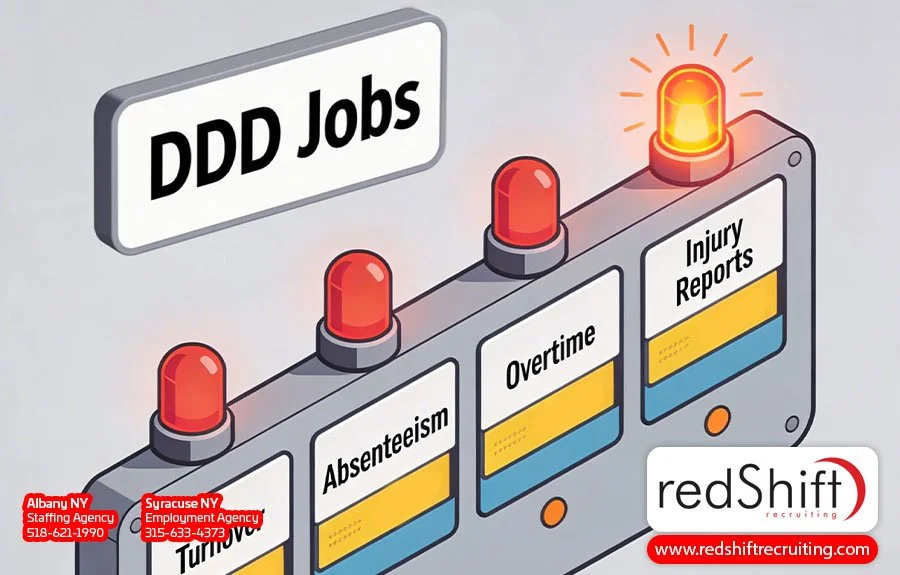
Frequently Asked Questions
Why Do Workers Avoid Physically Demanding or High-Risk Jobs?
Not everyone avoids DDD jobs. Many people genuinely prefer hands-on or physical work. However, social science research shows that when more options are available, workers are less likely to choose roles built around sustained physical risk or strain. These jobs can be physically and mentally taxing, sometimes carrying long-term effects on health and well-being. In certain environments, a single mistake can lead to serious consequences.
For workers living in poverty or facing urgent financial need, the compensation may justify the tradeoff. But in countries where access to education, training, and broader employment opportunities is available, fewer workers are likely to choose this type of role if alternatives exist.
What Is the Future of Human Workers in an Automated Economy?
The widespread use of automation, robotics, and artificial intelligence is reshaping how work is structured across the world, but that doesn’t mean the future is simply humans versus machines. In some sectors, repetitive tasks may be partially automated. In others, technology enhances human performance, allowing human workers to be more efficient and effective rather than replacing them.
Over time, this dynamic will make unique human capabilities increasingly valuable—traits like adaptability, problem-solving, contextual decision-making, and relationship-building. As industries evolve and automation becomes less of a novelty, the focus will likely shift from replacing labor to redesigning how humans and systems work together.
The long-term challenge is not just whether we can (or should) automate, but how workers and organizations can adapt responsibly as the economy changes.
Can Artificial Intelligence Technology Replace Dull, Dirty, and Dangerous Jobs?
In some cases, yes. Artificial intelligence, automation, and robotics are increasingly used to reduce human exposure to physically hazardous environments. In settings like mine exploration, deep-sea operations, large-scale manufacturing, and other high-risk industries, robots can perform repetitive or dangerous tasks that would otherwise be done by humans. This has exciting potential to even expand certain areas of space exploration or hazardous site remediation that would otherwise require extreme physical risk.
However, most DDD roles involve fast-paced and dynamic environments that still require judgment, flexibility, and real-time decision-making. While technology can assist or partially automate portions of the work, full replacement remains complex. The future is likely to involve collaboration between human operators and intelligent systems rather than total substitution.
How Does Decision-Making Differ Between Humans and AI in High-Risk Environments?
Machines process data quickly, while humans interpret context. In high-risk environments, automation can follow programmed rules and detect patterns, but a human operator’s judgment still matters when conditions change unexpectedly. Weather shifts, equipment malfunctions, and real-time safety concerns often require flexible thinking that goes beyond programmed responses.
The key difference is that AI responds to predefined inputs, while humans weigh nuance, uncertainty, and competing priorities in the moment. That ability to interpret gray areas—not just execute instructions—is critical in environments where mistakes carry serious consequences. As technology advances, the balance between human oversight and artificial intelligence (AI) continues to evolve. But for now, complex physical environments still rely heavily on human adaptability.
How Can Organizations Adapt to Structural Labor Constraints?
Adaptation begins with recognition. Structural labor constraints are not limited to one industry, one region, or one economic cycle. As demographics shift and expectations evolve, organizations must rethink how work is structured, not simply how it is staffed.
That may include reassessing job design, exploring responsible uses of technology, investing in workforce development efforts, or considering where certain tasks can be automated at scale. In some cases, collaboration with universities or training partnerships can help prepare future workers to meet these evolving demands.
Rather than eliminate jobs, the aim is to align work more realistically with long-term human sustainability while maintaining performance across the broader economy.
Conclusion
Dull, dirty, and dangerous roles break first in a labor shortage, not because people refuse to work, but because the structure of the work itself is difficult to sustain.
For years, excess labor masked the strain built into these jobs. When that excess disappeared, the cracks became clear. This isn’t simply about pay or motivation; it reflects a shift in how workers weigh risk, stability, and long-term opportunity.
That brings up a harder question: what happens when the roles that quietly support everything else can no longer be reliably staffed? In the next article, we’ll examine what breaks when these foundational positions remain unfilled—and how their absence reshapes performance across entire systems.


Article Author:
Ashley Meyer
Digital Marketing Strategist
Albany, NY
from Career Blog: Resources for Building a Career - redShift Recruiting https://www.redshiftrecruiting.com/career-blog/dull-dirty-and-dangerous-jobs
via redShift Recruiting



Comments
Post a Comment