What Breaks When Support Roles Go Unfilled

Labor shortages rarely begin with a visible collapse. More often, they creep in quietly, in the spaces between tasks. In healthcare, that might mean a delayed patient transport or supplies arriving a little later than expected. In manufacturing, it could be materials staged just behind schedule. In logistics, it may look like a support team stretched thin across long hours, trying to keep pace with fluctuating demand. Even in organizations with geographically dispersed teams relying on remote technical support staff to hold everything together, strain can show up as slower responses to technical issues or delays in restoring access to critical systems.
These aren’t dramatic failures that make headlines: they’re operational details. But details matter.
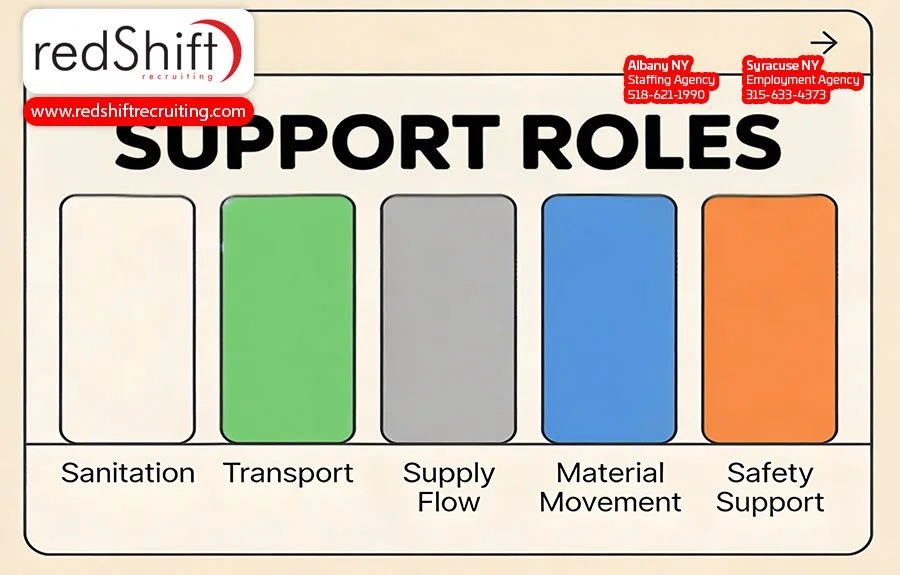
The roles behind those details are often grouped under the broad label of support roles. They include sanitation, material movement, supply coordination, equipment setup, stocking, and a range of other responsibilities that keep daily operations moving. These jobs may not appear in strategic planning decks. They are not typically seen as the primary role in delivering care, serving customers, or producing goods. But when they go unfilled, the whole organization feels it.
Nurses spend valuable time tracking down supplies. Skilled technicians handle basic material movement. Managers shift from oversight to coverage, and supervisors step in to coordinate schedules, answer phones, or move work through the system manually. What begins as filling in for a temporary staffing gap can gradually reshape how work is done across the entire organization, reducing productivity, delaying service, and leaving important skill sets underutilized.
This article examines what happens when support roles go unfilled and how these foundational staffing gaps alter the stability of the systems we rely on.
Why Support Roles Are Structural Infrastructure—From Environmental Services To Remote Technical Support
Every hospital, manufacturer, logistics provider, and technology-driven company operates through layered systems of work. At the forefront are professionals closely associated with the mission—clinicians delivering care, engineers solving complex problems, service representatives focused on customer satisfaction, and sales teams managing relationships with clients and partners. But beneath that visible layer is a network of support roles that make that performance possible.
The word “support” can imply these positions are secondary, as if they sit at the margins when, in reality, they often form the foundation of a company's day-to-day operations. Like dull, dirty, and dangerous jobs, they are easy to overlook in planning, and they rarely draw attention when things are running well. And yet they are the roles that keep everything moving. They maintain cleanliness and order. They move materials, restock supplies, and track inventory. They help manage access to shared resources and troubleshoot disruptions. In digital settings, they may include help desk and technical support jobs that keep technology such as computers, hardware, and internal systems working efficiently so teams can stay focused on their areas of expertise. In physical settings, they maintain the conditions that allow production lines, patient care units, and distribution centers to operate safely and consistently.
When these tasks are performed well, they often fade into the background. Equipment is staged before it is needed and supplies are replenished quickly. The broader operation runs steadily without interruption. The work simply flows because teams have the tools they need to do their jobs.
But maintaining that smooth flow is not automatic—and certainly not effortless. It depends on a wide range of people who are responsible for hundreds of tasks that collectively keep the entire operation on track. Their work creates an environment where revenue generation, care delivery, and outstanding service are possible, even if their individual job description isn't directly tied to sales targets, quotas, or visible results.
The core roles that are most visibly tied to revenue, growth, and brand reputation depend on this consistent support infrastructure. Without it, businesses begin shifting work, redistributing responsibilities, and asking highly trained employees to absorb tasks outside their primary role. At first, that adjustment may seem manageable. But when a temporary fill-in becomes long-term coverage, it strains the broader operation, pulls time away from work that drives growth and improvement, and steadily burns out employees.
Healthcare—When Workflow Strain Affects Care Delivery
In healthcare environments, the impact of unfilled support roles shows up directly in the quality of care patients receive. Environmental services teams are responsible for maintaining sanitation standards that allow rooms to turn over safely and on time. Patient transport ensures that individuals move from one department to another without disrupting tightly scheduled care plans. Meanwhile, effective supply and medication flow keeps clinicians from having to stop and search for what they need, preventing interruptions that can slow critical treatment.
When these roles are understaffed, it creates a pattern often described as task bleed. Nurses begin tracking down equipment, coordinating room readiness, or locating missing supplies. Clinicians step out of patient rooms to manage tasks normally handled through administration and unit support, redirecting time that would have been spent assessing patient health, answering questions, and delivering care.
Each interruption may seem small in itself, but it breaks the sequence of care. A clinician pauses, resets, and then tries to return to the original task. Over the course of a shift, these restarts significantly reduce efficiency and make it harder for medical professionals to stay focused on patient needs.
What begins as a minor delay can quickly snowball into larger disruptions. A delayed room turnover slows admissions and pushes back discharges, holding patients in the system longer. A missing supply interrupts a medication pass. An uncoordinated transport creates gaps in the schedule that ripple through the rest of the day. That directly constrains patient throughput and increases length of stay (LOS)—two of the most closely watched financial and capacity metrics in modern healthcare systems. More handoffs are required, and more time is spent locating information, confirming readiness, and manually moving the process forward. Gradually, the role itself begins to shift, as jobs that once centered on patient interaction and clinical judgment become increasingly defined by coordination, paperwork, and constant catch-up. Care teams will adapt, but that adaptation comes at a steep cost.

Manufacturing—When Flow Disruptions Undermine a Dynamic Team
In manufacturing, the impact of unfilled support roles is most visible in the loss of rhythm. Production depends on timing—materials arriving when they are needed, equipment staged and ready, and work moving easily from one step to the next. Many organizations are now shifting from pure lean efficiency toward operational resilience, but resilience requires baseline coverage—and without support roles, there is no buffer to absorb disruptions. The line doesn't grind to an immediate halt, but it quickly becomes inconsistent.
Material movement delays are often the first sign. Components are not where they need to be, so operators step away from their stations to locate them. Scrap and trash from the previous shift haven’t been cleared, so workers must handle cleanup before they can begin their own tasks. Setup that would normally be completed in advance happens in real time, pushing back schedules. Machine errors and technical issues remain unresolved, bringing sections of the line to a stop for troubleshooting and maintenance. Work cannot move forward until these issues are addressed, so operators, technicians, and supervisors begin covering them on the spot, pulling time and attention away from their own responsibilities.
Over the course of a shift, these issues repeatedly slow the production sequence. A late start at one station changes the pace of the next. Equipment sits idle for short periods and then runs in uneven bursts. Supervisors spend more time rebalancing schedules, answering questions, and trying to assess what is ready and what is not. The line continues to move, but with more resets, more manual coordination, greater dependence on individual effort, and a growing need to correct small errors before they become quality issues.
This leaves less time for refining processes, mentoring and training less experienced employees, or applying specialized knowledge to spur innovation and growth. Instead of running a planned production schedule, the day becomes defined by the ongoing effort to keep work from falling behind.
Logistics & 3PL—When Volatility Meets Fragile Capacity
In logistics and third-party distribution, the pressure created by unfilled support roles is shaped by one defining factor: unsteady demand. Order volume rises and falls by the day, by the season, and sometimes by the hour. When that baseline coverage is thin, those normal swings in activity hit much harder.
A surge in inbound freight or a spike in e-commerce orders does not wait for the next shift to be fully staffed. Trailers still need to be unloaded, pallets still need to be moved, and orders still need to be picked and staged. In stable conditions, a dynamic team prepares each zone in advance so high volumes of product move efficiently. When support coverage is inconsistent, those transitions happen in real time. Associates move between roles, supervisors step onto the floor, and the day becomes a series of adjustments rather than a coordinated plan.
The physical nature of the work intensifies the strain. Many of these roles take place during overnight or early morning hours, require constant movement, and depend on precise handoffs between shifts. In high-turnover environments, new employees are continually learning the layout, the pace, and the expectations. When experienced support staff are missing, the responsibility of orienting the next generation falls to workers who are already just trying to keep up with volume. Time that would have been spent maintaining flow is redirected toward explaining processes, locating equipment, and resolving small breakdowns before they spread.
Whether freight is moving from New York to San Francisco, from Canada to Mexico City and Costa Rica, or across any other part of the world, the underlying dynamic is the same: when that baseline coverage is thin, volatility increases the chances of error. A delayed unload backs up the dock and pushes back replenishment, directly increasing dock-to-stock time and creating stockouts on the picking line. A staging gap slows picking. An incomplete handoff between shifts forces the next team to start by figuring out where the last team left off. Each correction requires additional touches, additional movement, and additional time.
Safety margins narrow under these conditions. Work that is normally paced becomes rushed. Clear aisles become temporary storage, and equipment is shared across more people than planned. Experienced employees spend more of their day answering questions, stepping into gaps, and helping others solve problems instead of focusing on the areas where their expertise makes the biggest difference. Together, these changes increase the likelihood of rework, mistakes, and preventable incidents that pull even more labor away from the floor.
The result is an environment where every peak feels higher, every shortfall lasts longer, and more of the day is spent getting the floor back under control instead of clearing the next wave of volume.
The Snowball Effect—From Delay to Deterioration
The first signs are small—a late start, a missed handoff, a task that rolls to the next shift. Most of the time, they are absorbed with extra effort or a few hours of overtime. But when those adjustments become routine, the day starts to look different.
Overtime turns into the plan instead of the backup. Time that would normally go to process improvement, workforce planning, or longer-term priorities is spent tracking down coverage, reworking schedules, and making real-time decisions as planned work is replaced by constant reactions to scheduling gaps and process breakdowns. Tasks that depend on focus and experience are repeatedly interrupted by the need to solve unexpected problems, reset priorities, and absorb work that should already have been completed.
The effects compound day after day as each delay creates a little more rework, and each rework cycle adds another opportunity for error. Service timelines stretch, quality checks catch more issues that have to be corrected manually, and more of the shift is spent restarting and rechecking instead of moving forward. Predictable sequences turn into fragmented workflows, and the whole operation begins to run in short bursts rather than in a steady progression.
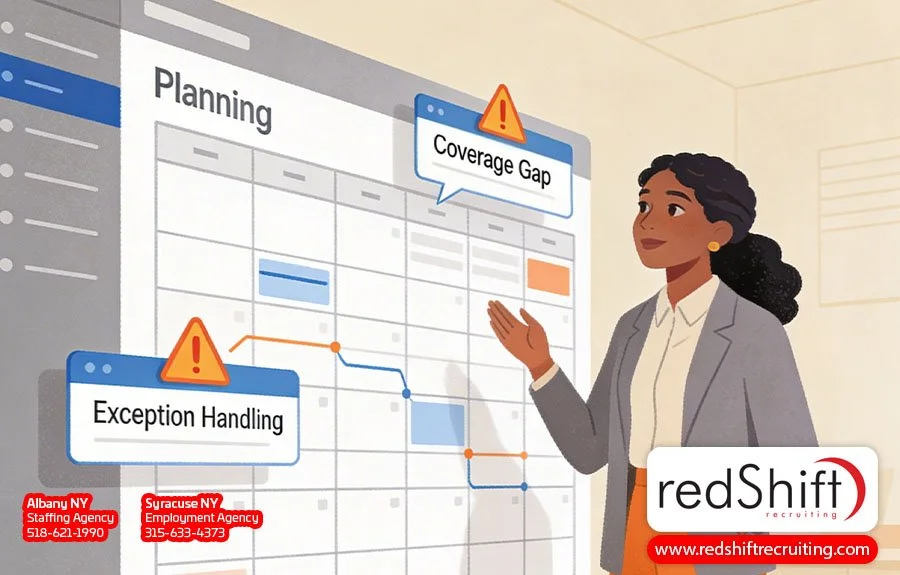
For employees, this creates a frustrating cycle of coverage and correction in place of opportunities for growing specialized skills, solving complex problems, or building the experience that moves their careers forward. Meanwhile, leaders find their focus pushed toward workload balancing, staffing gaps, and reactive decision-making just to keep operations stable. Floor coverage, exception handling, and staff management take priority over coaching, planning, and development. The work still gets done, but more of the organization’s energy goes into keeping things from slipping instead of making them better, and team members gradually become exhausted and burned out.
This is the point where a staffing issue becomes an operational constraint. The challenge is no longer a single open role or the ability to fill it. It's the growing share of time, attention, and pay devoted to recovery work instead of progress, taking the form of overtime hours, rework cycles, and constant schedule adjustments.
Seeing This In Your Own Operation?
These patterns rarely show up as a single obvious problem. More often, they look like overtime becoming routine, supervisors covering the floor, or highly skilled employees spending their time on basic coordination. We work with organizations that are navigating these dynamics every day. If you’re trying to stabilize throughput, protect workforce development, or make sense of hard-to-fill support roles, we’re always here as a resource.
Talk With Our Team
Frequently Asked Questions
When Does a Staffing Shortage Become an Operational Constraint?
A staffing gap becomes an operational constraint when the organization can no longer absorb disruptions by making normal adjustments, such as shifting schedules, adding a few hours of overtime, temporarily reassigning work, offering additional compensation, or delaying lower-priority projects. At that point, time and attention are consistently redirected toward covering gaps and making up work instead of innovation or process improvement. The issue isn't just the open role, but the growing share of the day spent simply keeping routine tasks on track. That shift limits a company's ability to be flexible, slows decision-making, and makes it harder to prepare for the future.
Why Do Small Delays Create Bigger Performance Problems Over Time?
Small delays matter because they rarely stay isolated. Each one requires additional actions—checking status, moving work manually, restarting a process, or confirming that the next step is ready. Over time, those extra steps compound and slow down the entire workflow. The power of a well-staffed company is in smooth and consistent operations. Once that rhythm breaks, more of the day is spent catching up instead of getting ahead.
How Does Constant Coverage Work Affect Long-Term Workforce Development?
When experienced employees spend their time covering gaps, they have fewer opportunities to mentor others, share knowledge, or build new skills. Newer team members lose the structured learning that helps them grow professionally, and opportunities for training become informal and inconsistent. In an environment that is constantly reacting to the next minor emergency, there is little time to slow down and create the learning experiences that support career growth.
What Is the Hidden Cost of Running in Continuous Recovery Mode?
The most significant cost is focus. Leaders who would normally evaluate systems, test new ideas, or decide on long-term priorities spend their time reacting to immediate needs, while teams that could be refining processes or improving service spend their energy running errands, coordinating handoffs, and tracking down missing information, materials, or approvals. The essential work still gets done, but the business shifts into survival mode and struggles to make real progress.
Why Do High-Performing Teams Struggle When Support Roles Are Unfilled?
Even the strongest teams depend on stable working conditions to perform at the highest level. When those conditions deteriorate, the workday shifts toward coverage and coordination rather than the specialized tasks they do best. Senior technical support staff spend their time unboxing and setting up computers, moving equipment between locations, or tracking down missing hardware instead of implementing new database tools or writing code for future improvements. Engineers step into day-to-day troubleshooting rather than leading new initiatives, and supervisors shift to unloading trucks, picking orders, and fixing inventory discrepancies instead of managing flow across the floor. High performance comes from effective staffing—the right people, in the right roles, with the right support.
How Does This Apply to a Remote Job or a Digitally Distributed Team?
For many people, one of the favorite parts of a remote job is the ability to maintain work-life balance while working from anywhere in the country—or even the world. That flexibility benefits employers as well, opening access to a broader hiring pool with skills and experience that may not be available locally. But it also makes a reliable support structure more important than ever. When access issues, platform interruptions, or unresolved requests slow down work, entire groups of users can be left waiting. When those problems are handled quickly, work continues without disruption, but when they aren’t, employees lose time navigating workarounds, repeating steps, or sitting idle while they wait for access to be restored.
Conclusion: Support Roles Are Structural, Not Secondary
Support roles are often categorized as secondary because they operate behind the scenes. They’re rarely represented in strategic planning conversations and often don’t have a clear voice in the boardroom, yet their presence determines whether those plans can be executed. Their absence does more than create inconvenience—it disrupts flow, redirects skilled work, and forces entire operations into constant recovery mode. What looks like a staffing gap at the surface is, in practice, a loss of stability. Relying on highly skilled staff to cover support gaps creates a form of operational debt—a short-term fix that quietly compounds into long-term structural weakness.
While these roles are not always the ones people associate with a long-term passion or a dream career, they shape the working conditions that allow every other position to succeed. These are the people committed to maintaining the environments, processes, and access points that make care delivery, production, and service possible. When that foundation weakens, even the most experienced teams lose the time and focus required to do their best work.
Operating complex organizations without enough structural support inevitably shifts energy away from progress and toward preservation. Over time, that changes what the organization is able to sustain, improve, and deliver. In the next article, we’ll look at what organizations have already done to try to close these gaps—and why many of those efforts, despite real investment and strong leadership, have struggled to produce lasting effects.

Article Author:
Ashley Meyer
Digital Marketing Strategist
Albany, NY
from Career Blog: Resources for Building a Career - redShift Recruiting https://www.redshiftrecruiting.com/career-blog/support-roles
via redShift Recruiting



Comments
Post a Comment