The Labor Shortage Isn’t Temporary: Why Today’s Staffing Challenges Are Structural
If role after role stays open despite your best efforts, it may be more than a tough market cycle—it may signal a structural labor shortage.

Why This Doesn’t Feel Like a Normal Hiring Cycle
There’s a difference between a tough hiring season and a system under strain. Even when organizations put more time and resources into hiring, roles seem to stay posted longer. Teams operate short-handed. Interviews are scheduled and offers extended, but the number of job openings doesn't seem to meaningfully decline. It doesn't feel like a typical slowdown in the market; it feels like something more systemic.
We often hear the phrase labor shortage thrown around in news articles and board meetings, but the more frequently it’s used, the easier it is to miss what’s really happening underneath it. If this were simply a matter of effort, incentives, or speed, we would expect conditions to improve once those levers were pulled. Instead, staffing constraints are appearing across industries, suggesting the pressure isn’t confined to one region, one sector, or one type of role. The question many business leaders are asking isn’t “How do we try harder?” but “Why isn’t trying harder changing the outcome?”
Before we can talk about solutions, it's worth asking a more fundamental question: What if the imbalance between demand and available workers reflects a structural constraint within the U.S. economy—one that changes how we think about growth, planning, and operational capacity?
Why Job Openings Stay High Despite Increased Hiring Effort
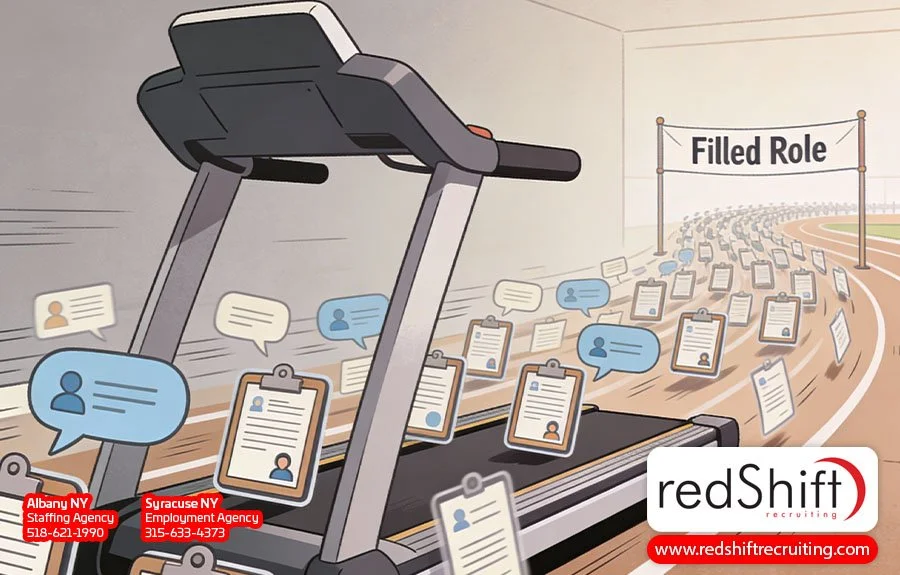
Over the past several years, recruiting activity has intensified for many employers. Across the country, businesses have expanded sourcing efforts, added recruiters, experimented with new outreach channels, and refined their hiring strategies. HR managers are working longer hours, and leadership teams are getting more involved in identifying the right candidates. Yet in spite of all that effort, the number of open roles doesn't seem to get any smaller. Availability is shaped not only by how many people are in the labor force, but by whether their skills, location, timing, and readiness align with current demand.
This pattern highlights a sharp disconnect between hiring effort and workforce capacity. Whereas hiring activity reflects how hard organizations are trying to find workers and fill roles, workforce capacity reflects how many people are actually available, have the right skill set, and are ready to step into those roles within the broader labor market. When those measures don’t move together, it suggests the problem may not be effort at all, but underlying capacity.
At a national level, the volume of open jobs remains high compared to longer-term historical norms, although it has cooled from the extraordinary heights of 2021 and 2022. According to the U.S. Bureau of Labor Statistics Job Openings and Labor Turnover Survey (JOLTS), job openings totaled roughly 7 million in late 2025, down from peak pandemic-era levels, but still above the typical range seen through much of the mid-2010s. While openings have moved closer to pre-pandemic levels, millions of roles remain unfilled at any given time. Even though overall employment has significantly recovered in recent years, that persistent imbalance suggests ongoing labor demand continues to exceed more typical long-term patterns.
That dynamic can feel counterintuitive to job seekers, many of whom describe today’s market as competitive and uncertain. Even with relatively low headline unemployment, the experience of finding the right role can take longer than expected, and many job seekers express frustration with prolonged hiring processes, automated screening systems, poor employer communication, and increased competition for fewer opportunities. This tension reflects friction in the system rather than a surplus of opportunity. Employers may have open roles, but they are seeking candidates whose skills, experience, and availability closely align with operational needs. The specific combination of qualifications and conditions they require does not always perfectly overlap with the available candidate pool, and in some cases, the misalignment is reinforced by a gradual rise in credential expectations. Roles that once required limited formal education now ask for degrees or multiple years of experience, creating higher thresholds that can unintentionally narrow the candidate pool and leave capable individuals on the sidelines. The result is a complex market that can feel tight for employers and difficult for candidates at the same time.
When analyzing these trends, it's tempting to look for simple explanations. Some assume organizations are setting unrealistic expectations or making avoidable mistakes, while others think that employees are less motivated or less willing to work certain schedules or roles. Certainly, in individual cases, hiring challenges can stem from misalignment between job requirements and candidate experience, uncompetitive compensation, poor management quality, or unreasonable expectations. But when businesses across industries experience similar strain, it signals something broader than isolated missteps.
What we can conclude is that the fundamental issue isn't either employers or job seekers not trying hard enough. Instead, there appears to be a widening gap between labor demand and overall supply. When demand rises across multiple parts of the system at once, competition for available talent intensifies. Roles may shift between organizations or industries, but that movement does not increase the total number of people in the system or expand the skills available within the workforce.
In practical terms, hiring effort often redistributes labor rather than expanding it. Skilled workers move between employers, between industries, or into different roles within the same sector. Positions are filled, but new vacancies appear elsewhere, and the total number of available workers remains largely unchanged.

Labor Demand vs. Labor Availability
To understand why staffing pressures persist, it helps to distinguish between labor demand and labor availability. Labor demand reflects the amount of work that needs to be done across an economy: the roles required to sustain operations, serve customers, and support business growth. Labor availability reflects the number of people in the workforce who are able, willing, and prepared to perform that work. Pressure builds when the balance between workers and open roles gets out of sync.
Opportunity can vary significantly across industries. For example, while tech has recently seen a decline in certain roles, many jobs in healthcare, construction, and manufacturing remain in consistently high demand. These roles are essential to maintaining critical services and infrastructure, yet the pool of available labor has not grown at the same pace as the demand for those services. The number of open jobs can remain significant even when many unemployed job seekers are actively searching, because hiring for many companies is not simply about maintaining headcount—it's about finding workers whose skills, location, and availability meet with current needs.
Reaching that intersection between available workers and open roles has grown more complex over time. Labor supply is shaped by a range of overlapping factors contributing to pressure on the hiring market: an aging population and rising numbers of older workers retiring, shifts in labor force participation, changing patterns of immigration, evolving worker expectations around work hours and remote work, and the growing influence of artificial intelligence (AI) and other technologies reshaping required skills and job design. At the same time, many roles now require more specialized or updated capabilities, increasing reliance on skills-based hiring and placing greater emphasis on technical training pathways, including apprenticeships, certification programs, and trade schools.
None of these forces alone explains persistent workforce shortages. Together, however, they create a cumulative, systemic pressure. In many sectors, economic demand has expanded faster than the underlying labor supply available to support it. Fewer people entering certain occupations, slower labor force growth over recent decades, and uneven access to education and career pathways all contribute to a tighter balance between supply and demand. As larger generations retire and smaller ones enter the workforce, the basic demographic math makes it more challenging for the labor pool to grow.
This is less a malfunction of the system and more a reflection of how labor markets evolve over time, particularly in advanced economies where demographic and productivity patterns often shift gradually rather than abruptly. Understanding that distinction helps clarify why simply increasing recruiting effort does not automatically increase workforce capacity.
Why Traditional Recruiting Efforts Aren’t Curing Labour Shortages
Over the past several years, many companies have responded to staffing pressure by increasing recruiting activity. This has included expanding job postings, shortening hiring cycles, broadening sourcing channels, and introducing new incentives to attract and retain top talent. Some have raised wages, offered additional bonuses or enhanced benefits, or allowed more flexibility in scheduling and remote work arrangements to better compete.
These efforts aren't wasted—in fact, they contribute to job satisfaction and retention, which benefits both employers and employees. When roles remain unfilled, the instinct is to widen the search, accelerate hiring decisions, or make roles more attractive to both younger workers and experienced professionals through higher pay rates, increased perks and bonuses, or flexible options.
However, most of these approaches share a common limitation: they redistribute existing labor rather than increase total labor supply. Posting more openings increases competition; it does not create more workers. Offering higher pay may persuade someone to move from one employer to another, including between sectors, while expanded sourcing may reach candidates who were previously overlooked. But unless the number of people participating in the workforce grows, the overall system remains constrained.
These long-term trends are often shaped by demographics and participation patterns. In many advanced countries, workforce growth has slowed relative to previous decades, and in certain fields, there are simply fewer people entering specific career paths than in the past. Encouraging young people to consider other occupations or training experienced workers to develop new skills can help over time, but those shifts occur gradually and won't solve immediate labor shortages. Organizations may successfully hire, and workers may transition into other roles or industries, but the total number of people available to support essential operations is largely unchanged.
What all this reflects is a simple structural reality: traditional recruiting levers are designed to compete for existing labor, not to increase overall labor supply. When demand across an industry outpaces the number of people positioned to fill those roles, the result is persistent labor shortages—not because organizations are failing in their hiring efforts, but because the underlying workforce capacity has become a constraint.

Workforce Capacity as a Shared Constraint Across Industries
One of the clearest signals that this issue is structural rather than situational is its breadth. Staffing pressure is not confined to one region, one employer, or one type of role. It is visible across healthcare systems, manufacturing facilities, construction firms, logistics networks, and service-based businesses alike.
For example, in healthcare, organizations must maintain round-the-clock coverage to support patient care and essential services. In manufacturing and construction, timelines and production schedules depend on steady workforce availability. Meanwhile, in logistics and service industries, daily operations hinge on having enough trained workers present each business day to meet customer demand. While the specific roles may differ, the underlying issue is similar: workforce capacity is finite.
Furthermore, these sectors do not operate in isolation; they often draw from overlapping labor pools. A worker with technical training may be qualified for roles in both manufacturing and construction, while a licensed professional may move between healthcare settings. Administrative, customer service, IT, and maintenance professionals work across nearly every industry, which means multiple sectors may compete for many of the same people. Even if growth slows in one area, expansion in others can sustain pressure on shared labor pools.
This overlap matters. If staffing strain were limited to a single industry, labor might shift more easily from one sector to another, but when several industries experience pressure at once, movement within the system does not resolve the issue—it simply redistributes it.
This pattern is evident across the broader economy, not just in isolated communities. It reflects long-running demographic and labor force participation trends rather than a temporary disruption or any specific public policy decision. In many cases, organizations are competing for talent in markets where workforce growth has slowed over time, and where participation patterns among groups such as prime-age adults, women, older workers, and other segments of the labor force have evolved in ways that affect overall labor availability.
The key point is this: when demand expands across multiple parts of the economy at once, the shared labor pool does not automatically expand with it. That shared constraint—more than any single hiring tactic or industry-specific factor—is what links these pressures together.
Struggling to hire? We get it, and we’re here to help.
Our team works closely with employers across industries, giving us practical insight into how the labor market is changing and what that means for your hiring strategy. We help you adapt with clarity and hire with confidence.
Frequently Asked Questions
What Does a Structural Labor Shortage Mean?
A structural labor shortage refers to a sustained imbalance between labor demand and labor availability that cannot be resolved simply by increasing recruiting efforts. It doesn’t mean jobs disappear or that people are unwilling to work. Instead, it reflects deeper shifts in workforce growth, participation patterns, and the distribution of skills across the economy.
Unlike a short-term hiring slowdown tied to a single business cycle, a structural constraint suggests that the underlying capacity of the workforce is not expanding fast enough to meet demand. That distinction matters because it changes how organizations plan for growth, staffing, and operational continuity.
Why Are There So Many Job Openings if Unemployment Is Low?
This is one of the most common points of confusion. A low unemployment rate does not automatically mean there is ample labor supply. Unemployment measures people who are actively seeking work, but it does not capture those who have stepped out of the labor force or reduced their participation. It also doesn't reflect whether the skills, location, or availability of active job seekers align with specific roles.
In addition, when multiple industries expand at the same time, they often compete for overlapping groups of workers. Even if millions of people are employed, open positions can remain high because demand across sectors exceeds the number of individuals able to step into those roles immediately.
How Can There Be a Labor Shortage and Layoffs at the Same Time?
Layoffs in one sector do not automatically translate into immediate relief in another. Workforce capacity is not evenly distributed across industries or occupations. A reduction in hiring in the IT industry, for example, does not necessarily increase staffing levels in healthcare, construction, or logistics.
Not all skills are interchangeable, and transitions between fields take time. As a result, parts of the economy can experience contraction while others continue to face persistent labor shortages. Both realities can exist simultaneously without contradicting one another.
Why Haven’t Hiring Efforts Solved the Labor Shortage?
Many organizations have expanded recruiting strategies in good faith—increasing postings, improving compensation, and offering greater flexibility. These efforts can improve retention and attract candidates from competitors, but they typically redistribute labor rather than expand total workforce supply.
Unless participation rates increase or the number of people entering the labor force grows meaningfully, the overall system remains constrained. In other words, recruiting activity affects competition within the market, but it does not automatically increase overall capacity.
How Do Labor Shortages Affect Business Growth?
When workforce capacity tightens, growth planning becomes more complex. Organizations may delay expansion, adjust production timelines, or scale back service offerings based on staffing realities rather than demand alone.
In some service-based industries, labor can represent a large share of total operating costs—often approaching half or more—making workforce constraints a central strategic issue rather than a temporary inconvenience. When multiple sectors face simultaneous hiring pressure, competition for workers intensifies, influencing not only staffing decisions but also productivity, pricing, and long-term investment plans.
Conclusion: Why This Framing Matters for Employers
How leaders interpret today’s staffing challenges shapes how they respond to them. If the current labor shortage is viewed as a temporary disruption, the assumption is that conditions will normalize on their own. Hiring will get easier, capacity will rebound, growth plans can proceed largely unchanged.
But if the imbalance reflects a structural constraint, the implications are different. A structural labor shortage doesn't mean the economy is failing or opportunity has disappeared. It means workforce capacity is expanding more slowly than demand in key sectors. That reality affects how organizations approach growth planning, service delivery, operational expectations, and even capital investment decisions. Misdiagnosing a long-term constraint as a short-term fluctuation can lead to overextension, missed targets, or unrealistic assumptions about how quickly roles can be filled.
Structural does not mean hopeless. It means planning must align with reality. Organizations that recognize this shift can make more grounded decisions about expansion, staffing models, and operational resilience.
In the next article, we will take a closer look at which types of roles tend to feel strain first when workforce capacity tightens—and why those pressures often manifest long before broader economic indicators change.


Article Author:
Ashley Meyer
Digital Marketing Strategist
Albany, NY
from Career Blog: Resources for Building a Career - redShift Recruiting https://www.redshiftrecruiting.com/career-blog/labor-shortage
via redShift Recruiting



Comments
Post a Comment