Humanizing the AI-Assisted Resume: How to Stand Out Without Sounding Like a Bot
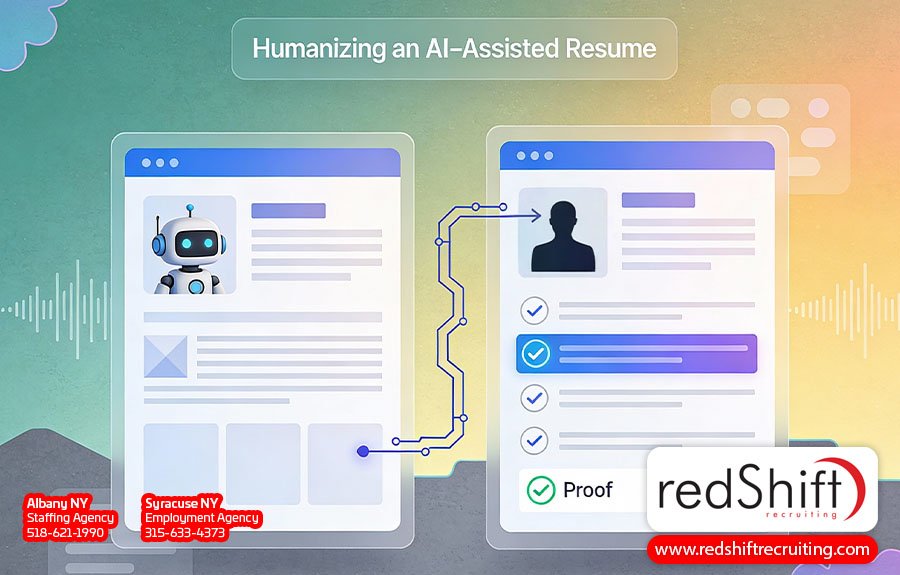
Let’s state the obvious: a lot of job seekers are using AI to write their resumes and other application materials. Recruiters know it. Hiring managers know it. Applicant tracking systems (ATS) know it. As AI-generated content becomes increasingly common, the big question isn't whether you're using these tools—it's how you're using them.
Generative AI can genuinely help level the playing field for job seekers of all experience levels and backgrounds. Whether you struggle to describe your experience clearly, English is your second language, or you simply don’t have hours to spend tailoring every application, AI tools can help you draft a resume that puts your best foot forward. The problem is what happens next.
Many AI-assisted resumes end up sounding exactly the same. They’re clean, confident, and packed with action verbs, but they lack specificity, context, and personality. Instead of helping you stand out, they make you blend in. In some cases, generic AI text can even cause an application to get skipped altogether.
Humanizing the AI-assisted resume means taking what AI produces and turning it into something that actually reflects you—how you think, how you work, and what you’ve really done. In this article, we’ll share what recruiters look for when reviewing resumes, the red flags that cause applications to get passed over, and how to refine AI-generated content so it sounds natural, credible, and genuine. AI can save you time, but it won't help you land interviews unless your resume still sounds like you—and gives a human reader a reason to keep reading.
How ATS Systems Read Resumes Today (It’s Not Just Keywords)
Before a recruiter ever sees your resume, it often passes through an applicant tracking system (ATS). These aren't secret gatekeepers designed to block qualified candidates because they missed a single keyword. They're essential tools that support busy (and often overwhelmed) recruiters who may receive hundreds of resumes in response to a single job post. The system doesn’t decide who gets hired, but it does filter, sort, and group applicants together for review. Understanding how an ATS actually works can help you cut through the hype and focus on what really matters.
ATS Systems Organize
Modern ATS systems are designed to sort resumes based on relevance. They look for matches between your experience and the job description, then group applications accordingly. Applicant tracking systems are not evaluating personality, potential, or cultural fit—and no, they’re not trying to “catch” you using AI. Your goal isn't to beat the system; it’s to make sure your experience is easy to categorize and easy to understand.
Keywords Still Matter—But Context Matters More
Keywords are still important, but they are most effective when they appear naturally inside clear descriptions of real work. ATS tools increasingly use semantic understanding to recognize related terms, skills, and phrasing rather than relying solely on exact matches. This is where many AI-generated resumes struggle. They often include the right words, but without enough context to show how those skills were actually used. As a result, an AI resume may technically fit the job description, but still feel thin or generic to a recruiter.
The ATS Is the First Gate, Not the Final One
An ATS helps organize incoming applications. What happens next is human review.
While automatic rejections do happen, they're usually the result of unreadable formatting or a basic mismatch with the role, not because of wording, tone, or the appearance of AI use. If your resume is clear, relevant, and readable, it will usually make it through this first step and reach a human reviewer. You don’t need aggressive ATS optimization, complex formatting tricks, or keyword stuffing. You need accuracy, clarity, and alignment.
Put simply: you don’t need to outsmart the ATS. You need to make your experience legible to both the system and to the people who ultimately review it.

Writing High-Signal Resume Content (What Actually Stands Out)
Once your resume makes it through initial screening, the next question recruiters and hiring managers are asking is simple: Is this worth a closer look? At that stage, success comes down to clarity and readability.
Short and Specific Beats Long and Generic
Shorter, focused resumes consistently outperform longer, generic ones. Recruiters don’t read every word line by line—they scan. They’re looking for clear indicators of capability, judgment, and fit, not keyword density. For recruiters, the signs of a strong candidate usually show up in the first few bullets of each role—clear outcomes, defined responsibilities, and evidence of ownership.
These "high-signal" resumes make it easy to see:
-
What you actually did,
-
Where you applied your relevant skills, and
-
What changed as a result of your work.
By contrast, AI’s mass-produced applications tend to blur together. When every bullet sounds impressive but vague, it’s hard to tell one candidate from the next and can raise suspicions of AI "workslop”—applications optimized for speed and formatting, not meaning or accuracy.
For example, instead of a generic statement like “Utilized advanced leadership skills and AI-driven tools to optimize team workflows and improve productivity,” a high-signal resume uses specific context and outcomes, such as “Led a cross-functional team of 12 to pilot an AI-automated inventory system, reducing manual entry errors by 30% and saving $15,000 per month in labor costs.”
The SOAR-AI Framework (A Practical STAR Evolution)
One way to increase relevance without adding length is to rethink how you structure bullet points. The traditional STAR method still works, but it can be updated for how people actually work and use technology today.
The SOAR-AI framework focuses on:
-
Situation – the context you were working in
-
Obstacle – the problem, constraint, or challenge
-
Action – what you did (including how you used AI tools, if relevant)
-
Result – the outcome or impact
The key difference is emphasis. This framework prioritizes judgment, tradeoffs, and decision-making over basic task lists. It helps recruiters understand how you think, not just what you’ve been exposed to.
Quantify Impact Where It Matters
Strong resumes anchor claims in outcomes. The simplest structure is:
Accomplished [X], measured by [Y], by doing [Z]
This doesn’t require perfect metrics, but it does require specificity. Quantifiable achievements—even rough ones—carry more weight than polished language. Numbers give hiring managers something concrete to evaluate, which can be a significant differentiator when your resume is going up against large volumes of similar applications.
Proof Over Claims
When possible, let your experience speak for itself. Simple “click for proof” signals add credibility quickly and give recruiters easy access to portfolios, GitHub repos, dashboards, or case studies where your best work is on display.
This matters because many recruiters approach AI-generated content with healthy skepticism. Unedited AI content can sometimes overgeneralize, assume context, or fill gaps in ways that don't accurately reflect someone's actual experience. When AI is trusted to do all the work without careful review, it can unintentionally make roles sound more senior or more comprehensive than they really were. Providing proof helps cut through the uncertainty, showing your resume is grounded in real work, not just well-written descriptions.
Describing AI Skills With Substance
Saying you are “proficient in AI” doesn’t tell a recruiter much. What they want to know is how you used it and why. High-signal resumes describe AI the same way they describe any other tool:
-
What problem it helped solve
-
How it fit into (and improved) your workflow
-
What it helped you accomplish more efficiently
This framing shows judgment and positions AI as something you applied intentionally, not as a shortcut that replaced thinking.

Humanizing the AI Draft (Where Most Resumes Fail)
AI can be a great starting point, but most resumes fall apart in the same place: the handoff from machine-generated draft to human review. From a recruiter’s perspective, this is where otherwise qualified candidates lose momentum.
“Too Perfect” Can Backfire
Over-polished resumes often raise more questions than confidence. That doesn’t mean you shouldn’t proofread for grammar or formatting issues. Those still matter, and mistakes can make a resume look careless or signal poor attention to detail. Where candidates tend to run into trouble is with highly uniform phrasing, repetitive patterns, and overly generic language. These are all common traits of AI-generated text.
That kind of writing isn’t inherently bad, but it can make your resume indistinguishable from other applicants using the same generative AI tools. More importantly, when a resume feels obviously AI-written, it can raise questions about whether the content accurately represents the candidate’s real experience. Recruiters review dozens of job applications daily and know that AI can exaggerate scope, smooth over gaps, or make roles sound more senior than they actually were, whether intentionally or because the content was never carefully reviewed.
This isn’t about AI detection tools “catching” anyone doing something wrong. It’s about trust and how the content lands with human readers. If a resume introduces uncertainty about accuracy, it can create red flags in the human review process—and that uncertainty can work against you, even if your underlying experience is solid.
Replace AI Filler With Ownership and Intent
AI drafts rely heavily on safe, vague verbs. Words like spearheaded, leveraged, or assisted can sound impressive, but they hide ownership. In contrast, humanized resumes use word choice to clarify responsibility, such as:
-
built instead of contributed
-
fixed instead of supported
-
analyzed instead of worked on
Strong verbs and human-sounding language help recruiters understand what tasks you actually owned and how you applied your relevant skills. Instead of letting AI do all the work, slow down and take time to refine AI-generated text, restoring clarity and accountability while ensuring the text sounds human and, most importantly, accurate.
Close the Context Gap AI Can’t Fill
AI is good at writing professional summaries, but it struggles with context. That missing 10% is often what matters most to hiring teams. This includes:
-
constraints you were working under
-
tradeoffs you had to make
-
team dynamics or business pressure
-
why a decision mattered at the time (not just what happened)
Adding context in your own words is a key part of humanizing AI-generated content. This improves clarity, preserves your original meaning, and ensures authenticity in your job descriptions. It helps your resume read like a real account of real work, not just a polished summary with ATS-friendly formatting. A fully AI resume should be your first draft—never your last.
Consistency Signals Credibility
In the modern hiring process, recruiters rarely rely on a resume alone to confirm eligibility. While your application and cover letter may help you land interviews, your experience needs to hold up to land a new job. If you're being considered for a role, most employers will review LinkedIn profiles, portfolios, or even social media posts to make sure the details match and your experience holds up under closer review.
This isn’t just about personal branding or professionalism. It’s about accuracy. When your job title, scope of responsibility, or timelines change across platforms, it creates doubt—especially when paired with generic language that sounds more AI than human. Consistency helps ensure your resume is accurate and recruiter-ready, not over-engineered.
The Read-Aloud Test (Simple, But Telling)
One of the easiest ways to catch problems is to read your resume out loud. Not only is this a proven method of catching errors, but it also helps you hear where the writing sounds generic, over-polished, or disconnected from how you would explain your work.
This doesn't mean your resume should be casual, sloppy, or full of slang. It should be professional, but also feel believable and natural for you at your best. Resumes should reflect your voice, tone, and style, while still meeting professional expectations for your industry. If it doesn’t sound human—or more precisely, if it doesn’t sound like you professionally—it needs revision.
Natural, humanized text is much easier to explain, defend, and expand on in a conversation with a hiring manager. If you don’t understand what the AI has written, how are you going to discuss it clearly in an interview?
Key takeaway: AI can help you create a draft, but it can’t ensure authenticity or credibility. Humanizing your resume means slowing down, reviewing carefully, and making sure the final version reflects real experience—not just great writing.

AI Is a Tool. Judgment Is the Skill.
From a recruiter’s perspective, the difference between a strong AI-assisted resume and a weak one has very little to do with the tools themselves. It comes down to judgment. AI can help you draft faster and improve clarity, but it can’t decide what’s accurate, what’s relevant, or what actually reflects your experience.
The resumes that hold up are the ones where candidates take ownership of the final result. They don’t rely on shortcuts to humanize AI text instantly. They review, revise, and make sure the writing sounds natural, reflects real work, and can be defended in conversation. When AI is used thoughtfully, it fades into the background. What stands out instead is credibility, clarity, and trust.
That judgment is becoming more visible—and more important—than ever, as transparency is increasingly a competitive advantage. As employers face growing expectations—and in some cases legal requirements—around how AI influences hiring decisions, transparency has become a two-way street. In a market where trust is the rarest currency, candidates who can clearly articulate where the machine ends and their judgment begins are the ones who get hired.
Ultimately, when used well, AI supports good decision-making. When used carelessly, it introduces doubt and erodes trust. That distinction matters far more than any tool name.
Want a quick way to sanity-check your AI-assisted resume?
Download our recruiter-approved checklist for spotting AI filler, improving clarity, and making sure your resume actually reflects your experience.

Frequently Asked Questions
Can Recruiters Tell if a Job Seeker’s Resume Was Written by AI?
Recruiters can’t always tell with certainty whether a resume was written using AI, but they don’t need to definitively “catch” AI use to sense when something feels off. Reviewing large volumes of applications makes them very familiar with common AI patterns, such as generic phrasing, vague accomplishments, or language that sounds polished but doesn’t say much of substance. When those patterns appear during human review, they often raise questions that rarely work in a candidate's favor. Some recruiters also use tools to detect AI content, but because generative AI is trained on human writing, these tools aren't always reliable.
Ultimately, what matters most to staffing professionals and hiring managers isn't whether AI was used to write your resume, but whether it is accurate, specific, and defensible in conversation. A resume that feels personal and grounded in real examples builds far more trust than one that is technically perfect, but clearly AI-written.
How Do You Humanize an AI-Generated Resume Without Rewriting It From Scratch?
You don’t need to start over to make AI content sound more personal. Instead, focus on editing for clarity, accuracy, and specificity. Replace vague verbs, add missing context, and adjust phrasing so the writing sounds natural to you. This kind of editing improves readability and makes the resume engaging for human readers, not just optimized for ATS software.
What’s the Difference Between an AI-Generated Resume and an AI-Assisted Resume?
An AI-generated resume is largely written by a tool with minimal review. An AI-augmented resume uses AI as a drafting aid, but relies on human judgment to refine accuracy, tone, and intent. The difference shows up in human-like writing—clear explanations, realistic scope, and language that reflects how the candidate actually works. From a recruiter’s perspective, this distinction matters because AI-augmented resumes are easier to trust, easier to evaluate, and easier to discuss in an interview than obviously AI-generated documents.
Are AI Humanizer Tools Safe for Job Seekers to Use on Resumes?
Both paid and free AI humanizer tools can be helpful when used carefully to transform AI-generated text. An AI humanizer helps smooth awkward phrasing or reduce repetition, but it shouldn’t replace thoughtful editing. The key is review. Overusing these tools can flatten nuance or subtly change meaning, while selective use supports clearer, more natural writing that still reflects your real experience.
Do You Need to Cite AI or List Tools on Your Resume?
In most cases, you don’t need to cite AI use when drafting your resume. However, if AI is directly relevant to the role, you should list specific AI skills, technologies, or other AI tools as part of your experience, just as you would any other job-related skill. Expectations can also differ for creative or technical roles, especially when AI-assisted work appears in a portfolio or other supporting materials. In those cases, transparency around how AI was used may be appropriate or required.
For standard application materials like resumes, LinkedIn updates, or social posts, however, recruiters care far more about accuracy and outcomes than which tools helped generate the draft. What matters most is whether the content clearly reflects your real experience.
Conclusion: Using AI Without Losing Your Voice
AI can be a powerful tool in the job search, but it works best as a co-pilot—not an autopilot. The strongest resumes use AI to support good writing, not to automate thinking. They’re specific about what was done, honest about scope, and grounded in real examples that can be explained and defended. A resume that is engaging to human readers isn’t one that sounds perfect—it’s one that sounds believable, accurate, and reflective of real work.
In an increasingly automated hiring market, clarity and authenticity remain competitive advantages. If you choose to use AI, use it intentionally so your resume stays recruiter-ready, credible, and unmistakably yours.
A strong, humanized resume is an important first step—but it’s rarely the whole story.
The candidates who move fastest are often the ones who pair a clear resume with real conversations and market insight. If you want help pressure-testing your resume, understanding what hiring managers are actually looking for, or connecting directly with employers, a recruiter can help bridge that gap.
👉 Talk With a Recruiter

Article Author:
Ashley Meyer
Digital Marketing Strategist
Albany, NY
from Career Blog: Resources for Building a Career - redShift Recruiting https://www.redshiftrecruiting.com/career-blog/humanizing-the-ai-assisted-resume
via redShift Recruiting



Comments
Post a Comment